

What is the finding
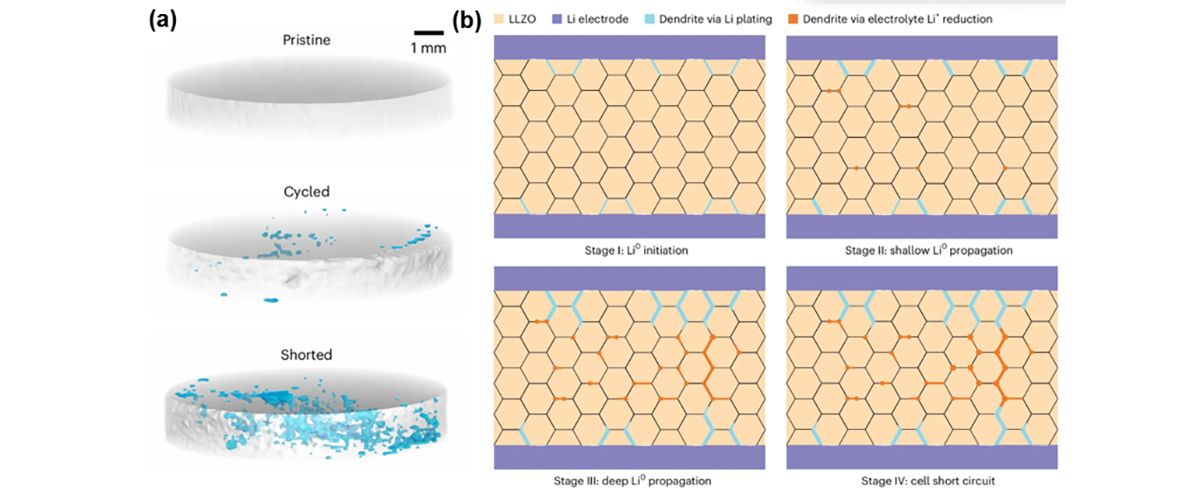
Using advanced nuclear magnetic resonance (NMR), magnetic resonance imaging (MRI), and electron paramagnetic resonance (EPR) techniques, scientists discovered that harmful lithium “spikes” (dendrites) form in solid-state batteries through two different pathways: One pathway resulting from uneven lithium metal deposition at the electrode surface, while the other originating from lithium-ion reduction inside the solid electrolyte. These processes occur at different rates and together drive battery failure.
Why is this important?
Solid-state batteries are a promising next-generation energy storage technology because they can potentially store more energy and offer improved safety compared with conventional lithium-ion batteries. However, the growth of lithium dendrites - needle-like metallic structures that can penetrate the electrolyte and short-circuit the battery - remains a major barrier to commercialization. This work provides the first direct, non-invasive observation of two distinct dendrite formation mechanisms operating within the same battery system. By identifying where and how these failure pathways originate, this study provides critical design principles for developing safer and longer-lasting solid-state batteries for electric vehicles, portable electronics, and grid-scale energy storage applications.
Who did the research?
H. Liu1, Y. Chen1, P.-H. Chien1, G. Amouzandeh1, 2, D. Hou3, 4, E. Truong1, I. P. Oyekunle1, J. Bhagu5, S. W. Holder5, H. Xiong3, P. L. Gor’kov2, J. T. Rosenberg2, S. C. Grant2, 5 & Y.-Y Hu1, 2
1FSU; 2CIMAR; 3Boise State University; 4Argonne National Laboratory; 5FAMU-FSU College of Engineering
Why did they need the MagLab?
This research required the unique high-field magnetic resonance capabilities available at the National High Magnetic Field Laboratory. The MagLab’s 21.1T, 19.6T and 11.75T NMR/MRI systems, together with specialized instrumentation and expertise, enabled researchers to see inside working batteries without damaging them and track lithium movement and dendrite growth with a level of sensitivity and spatial resolution not available through conventional techniques. These unique capabilities made it possible to distinguish the two dendrite formation pathways and understand how they develop during battery operation.
Details for scientists
- View or download the expert-level Science Highlight, Unraveling Dendrite Formation in Solid-State Batteries
- Read the full-length publication, Dendrite formation in solid-state batteries arising from lithium plating and electrolyte reduction, in Nat. Mater.
Funding
This research was funded by the following grants:K. M. Amm (NSF DMR-2128556); Y.-Y Hu (NSF DMR-2319151); H. Xiong (DOE DE-SC0019121)
For more information, contact Zhehong Gan.