


The MagLab is funded by the National Science Foundation and the State of Florida.
The MagLab is funded by the National Science Foundation and the State of Florida.
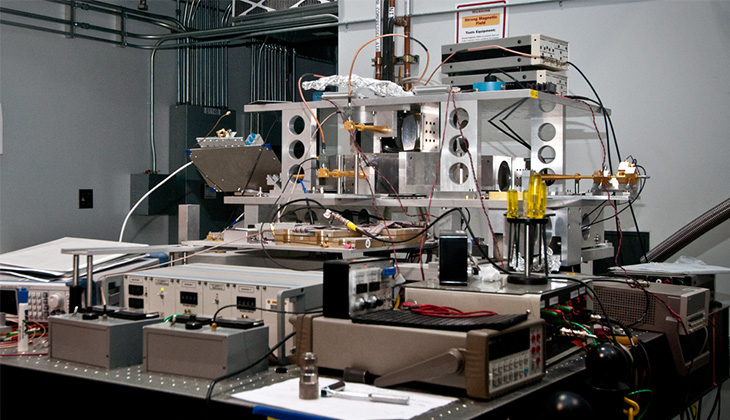
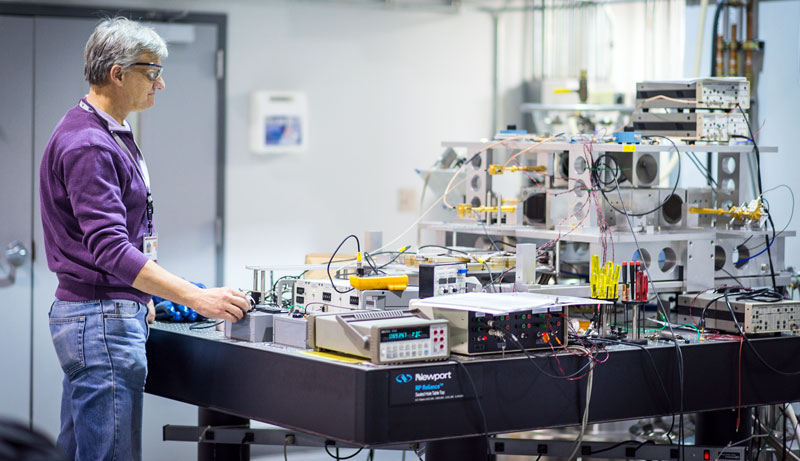
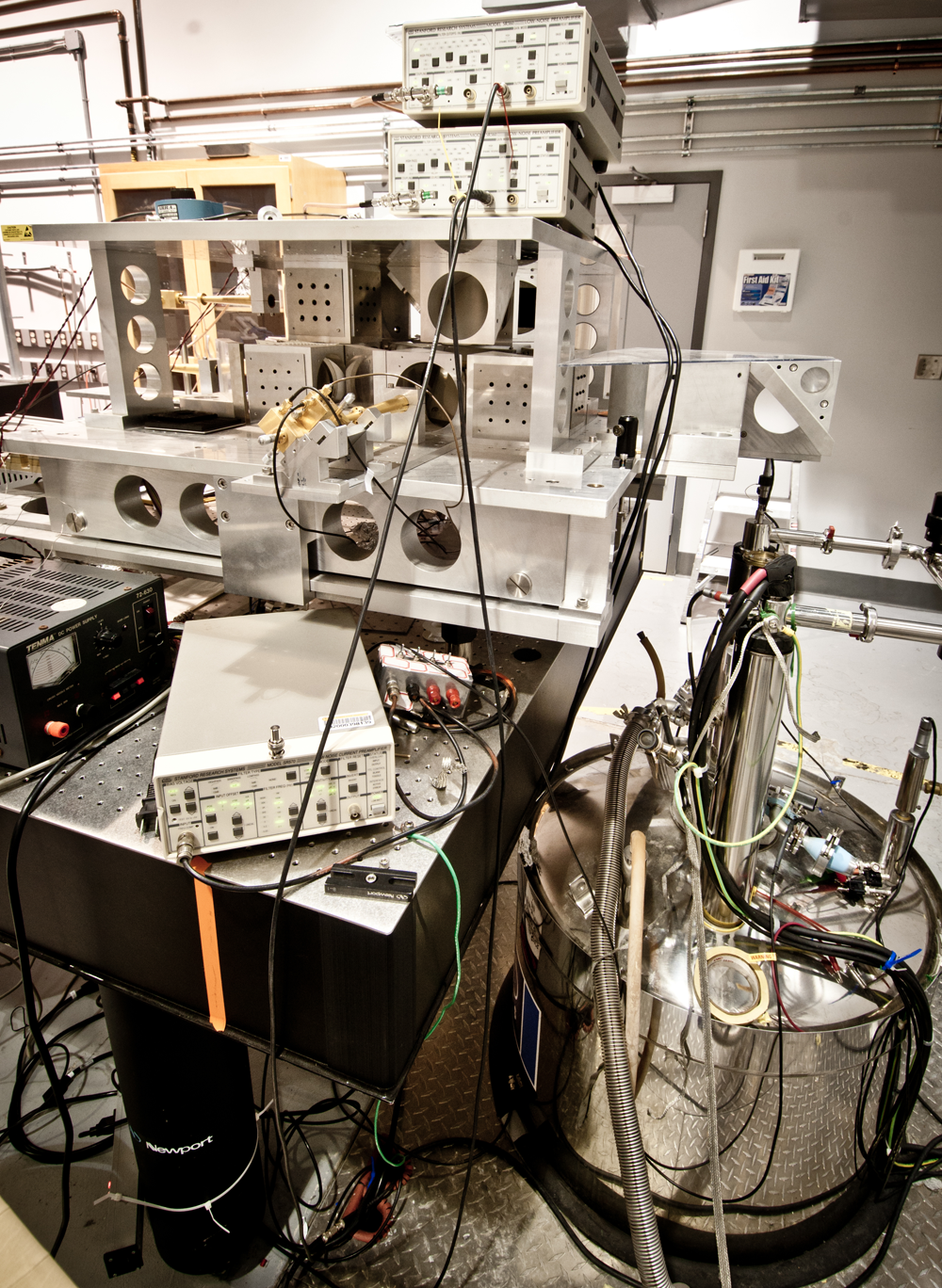
This 120-336 GHz instrument is coupled to a 12.5 tesla superconducting magnet with a homogeneity of 10-5 over a 10 mm sphere.
This instrument that we refer to as the quasi-optical heterodyne spectrometer is a multi-frequency instrument that can be used both for cw- and pulsed EPR. It consists of a multi-frequency quasi-optical millimeter-wave bridge coupled to solid state millimeter wave sources and employs Schottky-diode mixers as principal detectors.
The detection bandwidth is ~1 GHz and it is suitable for both transient and pulsed EPR. Phase sensitive detection is used with simultaneous detection of the in- and out-of-phase signals. The instrument is also equipped with RF sources and amplifiers for pulsed and cw Electron-Nuclear Double Resonance experiments to measure unresolved hyperfine interactions.
Normally the instrument is used without resonator, which allows rather large samples up to a volume of ~200 microliters. The instrument is equipped with a single axis rotator with an accuracy of 0.5 degrees. The maximum single crystal dimensions for the standard rotator are 2x2x2 mm, but larger samples can also be accommodated.
In CW mode, field modulation is used. In pulsed mode, without resonator π/2 pulse lengths are of the order of 400 ns. For single crystals a simple HE11 resonator can be used, which reduces these pulse lengths to about 100 ns.
Available frequencies are 120, 240, 266, 316, 336, and 395 GHz. The sample temperature can be controlled over the range of 1.5K to 400K.
The latest addition source and detector operate at 258-267 GHz with a power around 250 mW, resulting in pulse lengths as short as 200 ns without resonator and considerably shorter with a simple resonator. In the near future (late 2026) an Arbitrary Waveform Generator will be employed to generate arbitrary excitation pulse sequences.
Superconducting Magnets
Explore our magnet schedule to see what exciting research is happening on our stellar fleet of instruments right now.
Credit: National MagLab

Miao, Z.; Scott, F.; van Tol, J.; Bowers, C.R.; Veige, A.S.; Mentink-Vigier, F., Soliton Based Dynamic Nuclear Polarization: An Overhauser Effect in Cyclic Polyacetylene at High Field and Room Temperature, Journal of Physical Chemistry Letters, 15, 3369-3375 (2024) https://doi.org/10.1021/acs.jpclett.3c03591
Martinez, R.; Uenguer, O.; Jackson, C.W.; Khan, F.; van Tol, J.; Zadrozny, J., Ligand-Nuclei Effects on Spin Relaxation in V(IV) Complexes, Inorganic Chemistry, 64 (30), 15588--15599 (2025) https://doi.org/10.1021/acs.inorgchem.5c01930
Lee, I.; Cen, J.; Molchanov, O.; Feng, S.; Huey, W.L.; van Tol, J.; Goldberger, J.E.; Trivedi, N.; Kee, H.; Hammel, P.C., Spin-orbit coupling controlled two-dimensional magnetism in chromium trihalides, Physical Review B, 113, 014401 (2026) https://doi.org/10.1103/qg64-ztxj
Thomas, B.; Jardón-Álvarez, D.; Carmieli, R.; van Tol, J.; Leskes, M., The Effect of Disorder on Endogenous MAS-DNP: Study of Silicate Glasses and Crystals, Journal of Physical Chemistry C, 127 (9), 4759-4772 (2023) https://doi.org/10.1021/acs.jpcc.2c08849
Morley, G.W.; Brunel, L.C.; van Tol, J., A multifrequency high-field pulsed electron paramagnetic resonance/electron-nuclear double resonance spectrometer, Review of Scientific Instruments, 79 (6), 064703 (2008) https://doi.org/10.1063/1.2937630
van Tol, J.; Brunel, L.C.; Wylde, R.J., A quasioptical transient electron spin resonance spectrometer operating at 120 and 240 GHz, Review of Scientific Instruments, 76 (7), 074101-1 (2005) https://doi.org/10.1063/1.1942533
Takahashi, S.; Hanson, R.; van Tol, J.; Sherwin, M.S. and Awschalom, D.D., Quenching Spin Decoherence in Diamond through Spin Bath Polarization, Physical Review Letters, 101, 047601 (2008).https://doi.org/10.1103/PhysRevLett.101.047601
Last modified on 13 April 2026

Search our magnets by field strength, bore size, and even technique.