

What is the finding
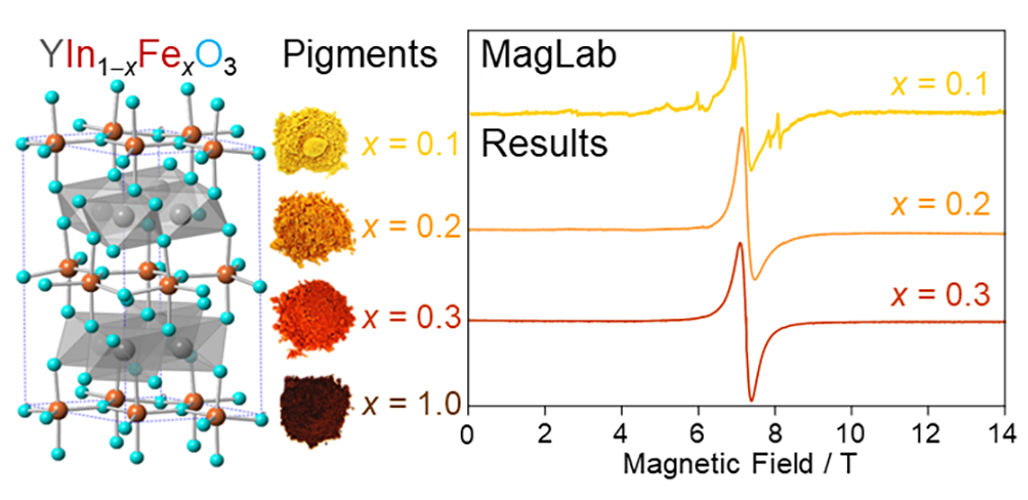
A material made from yttrium (Y), indium (In), and oxygen (O) is naturally off-white in color. However, replacing indium with other elements can lead to other colors. Earlier studies showed that substituting manganese (Mn) for indium yields a vibrant blue color known as YInMn which is used today in paints and heat-reflecting roof covers. In this new MagLab research, scientists found that replacing manganese with iron (Fe) produces colors ranging from yellow to orange to red depending on the amount of iron.
Why is this important?
Color pigments are used in countless products, from paints and coatings to plastics and construction materials. Understanding the origins of specific colors in these materials can help researchers design new pigments that are more visually appealing, cheaper, and less toxic. The findings also provide a roadmap for creating entirely new color pigments with tailored properties in materials.
Who did the research?
J. Krzystek1, Joshua Telser2, Peng Jiang3, Gopika M. Gopakumar3, Mas A. Subramanian3
1National High Magnetic Field Laboratory, 2Roosevelt University, 3Oregon State University
Why did they need the MagLab?
To understand why materials produce different colors, researchers needed extremely detailed information about the behavior of iron atoms inside the material. The MagLab's Electron Magnetic Resonance (EMR) Facility houses a specialized electron paramagnetic resonance (EPR) spectrometer that combines very high magnetic fields, about 1,000 times stronger than a refrigerator magnet, with high-frequency microwaves, about 100 times higher in frequency than those used in a microwave oven. These unique capabilities allowed researchers to precisely measure the iron-containing material and uncover the chemical and physical processes responsible for its yellow, orange, and red colors.
Details for scientists
- View or download the expert-level Science Highlight, High-Frequency and -Field Electron Paramagnetic Resonance Studies of Yellow/ Orange/ Red Pigments Based on Iron3+
- Read the full-length publication, Magnetic properties and electronic structure of manganese-based blue pigments: a high-frequency and -field EPR study, in Inorganic Chemistry
- Read the full-length publication, High-Frequency and -Field Electron Paramagnetic Resonance Studies of Yellow/Orange/Red Pigments Based on Fe3+ in Trigonal Bipyramidal Coordination, in Inorganic Chemistry
Funding
This research was funded by the following grants: K. M. Amm (NSF DMR-2128556); M. A. Subramanian (NSF DMR-2025615)
For more information, contact Jurek Krzystek.