

What is the finding
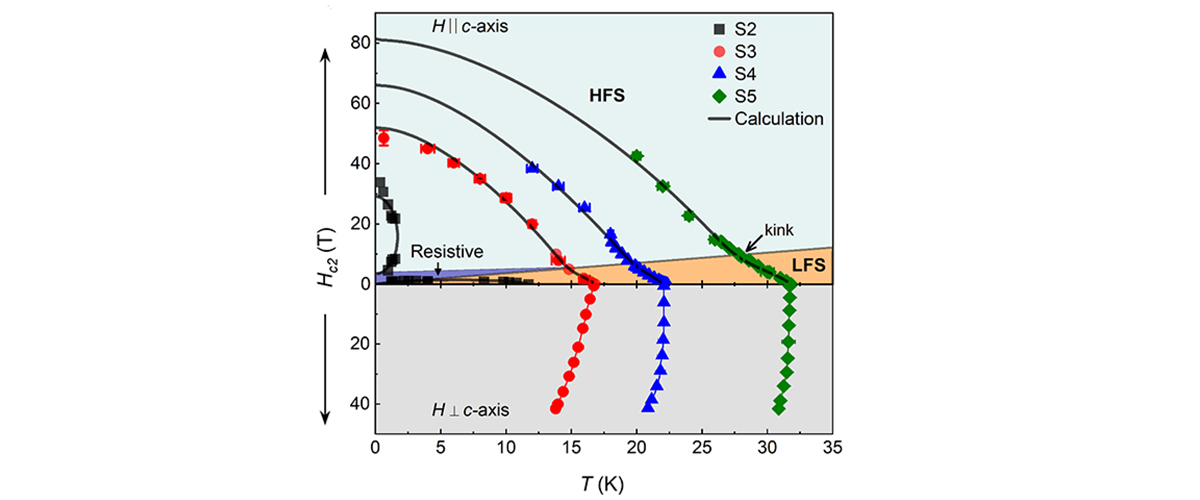
Scientists studying nickelates, an emerging family of superconducting materials, found that superconductivity can survive in surprisingly strong magnetic fields and, in some cases, even come back after disappearing. In certain nickelate samples, superconductivity vanished as the magnetic field increased and then reappeared at even higher field strengths. In other samples, superconductivity remained intact in magnetic fields of at least 65 tesla, more than 20 times stronger than a typical hospital MRI scanner. The researchers found that magnetism from europium atoms inside the material appears to partially cancel out the external magnetic field. Under the right conditions, this internal magnetic effect helps protect superconductivity instead of destroying it.
Why is this important?
Superconductors carry electricity without resistance, but strong magnetic fields usually destroy this ability. This work points to a different approach: engineering magnetism within a material to help protect superconductivity. This strategy could lead to more powerful superconducting magnets, sensors, and quantum devices that operate under extreme magnetic fields.
Who did the research?
K. Rubi1, K. Y. Yip2, E. Krenkel1, N. Fitriyah2, X. Gao2, S. Prakash2, S. L. E. Chow2, C. S. Tang2, T. F. Poon3, S. K. Goh3, S. M. Thomas1, A. P. Dioguardi1, O. E. Ayala-Valenzuela1, M.B. H. Breese2, M. K. Chan1, D. Graf4, A. Ariando2, and N. Harrison1
1Los Alamos National Laboratory 2National University of Singapore 3The Chinese University of Hong Kong 4National High Magnetic Field Laboratory
Why did they need the MagLab?
This unusual behavior could only be seen in magnetic fields far beyond those available in ordinary laboratories. The MagLab’s unique facilities provide fields up to 75 tesla, along with specialized low-temperature equipment and expertise for measuring tiny electrical and magnetic signals under these extreme conditions. These capabilities allowed researchers to track superconductivity as it disappeared, reappeared, and persisted under conditions unavailable at most laboratories.
Details for scientists
- View or download the expert-level Science Highlight, High-field reentrant superconductivity in nickelates
- Read the full-length publication, High-field-stabilized reentrant superconductivity in infinite-layer nickelate thin films, in Nature Communications
Funding
This research was funded by the following grants: K. M. Amm (NSF DMR-2128556); Neil Harrison (DoE “Science of 100 Tesla”)
For more information, contact Neil Harrison.