

What is the finding
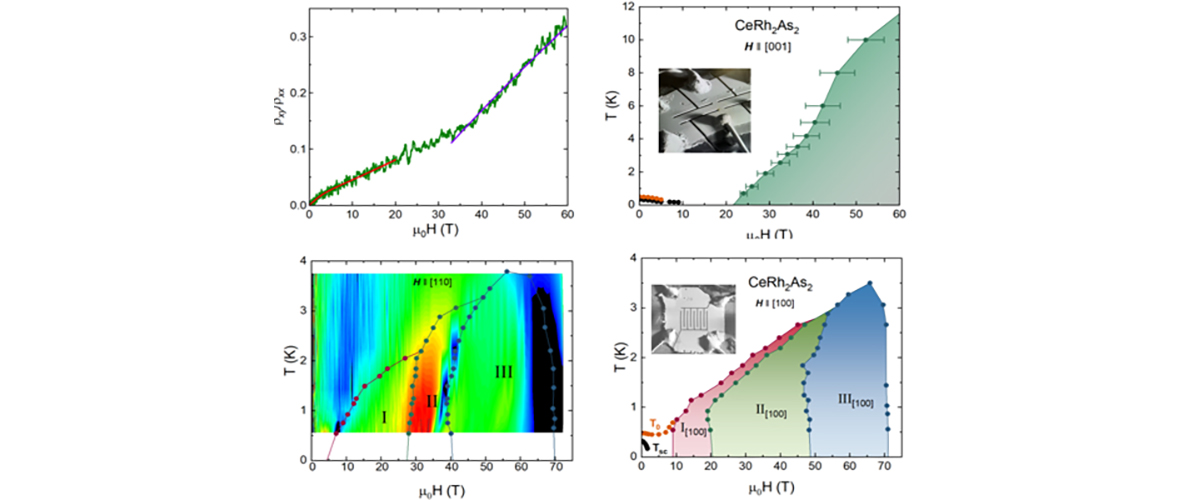
Researchers discovered that electrons in CeRh2As2 can abruptly change their quantum behavior depending on magnetic‑field direction and strength. With magnetic field perpendicular to the crystal layers, electrons suddenly localize on cerium (Ce) atoms at high fields.
With the field within the layers, electrons instead organize into three distinct, wave‑like ordered states. The boundaries between these states shift in precise, characteristic ways as field and temperature are varied. This demonstrates that multiple electronic ground states are in direct competition within the same material.
Why is this important?
These results show CeRh2As2 exists in a delicately balanced quantum regime where small changes in conditions push electrons into entirely different states.
This instability helps explain the material’s highly unusual superconductivity, which coexists with and competes against other quantum phases. Understanding this balance is critical for engineering superconductors and quantum materials with tunable properties. Insights gained here may help guide the design of future quantum‑computing or quantum‑electronic devices, potentially operating at higher temperatures.
Who did the research?
Joanna Blawat1, Grzegorz Chajewski2, Daniel Gnida2, John Singleton1, Oscar Ayala Valenzuela1, Dariusz Kaczorowski2, Ross McDonald1
1National MagLab, 2Institute of Low Temperature and Structure Research, Polish Academy of Sciences
Why did they need the MagLab?
This work was only possible using the unique capabilities of the National High Magnetic Field Laboratory. Focused Ion Beam lithography (co‑located with the Pulsed‑Field Facility) enabled fabrication of microscopic CeRh₂As₂ devices. Ultra‑high magnetic fields (up to 73 tesla)—the strongest available in the U.S.—were essential to access the competing quantum states. A custom 3D‑printed goniometer allowed precise rotation of samples while reaching temperatures as low as 0.5 K. Together, these capabilities reveal how extreme magnetic fields can uncover and control fragile quantum states crucial for next‑generation technologies.
Details for scientists
- View or download the expert-level Science Highlight, Competing electronic ground states in CeRh2As2
- Read the full-length publication, Competing Electronic Ground States in the Heavy-Fermion Superconductor CeRh2As2, in Physical Review X
Funding
This research was funded by the following grants: K. M. Amm (NSF DMR-2128556); J. Blawat, R. McDonald (CATS EFRC DEAC02-07CH11358); J. Singleton (DOE BES “Science of 100 T”)
For more information, contact Neil Harrison.