

What is the finding
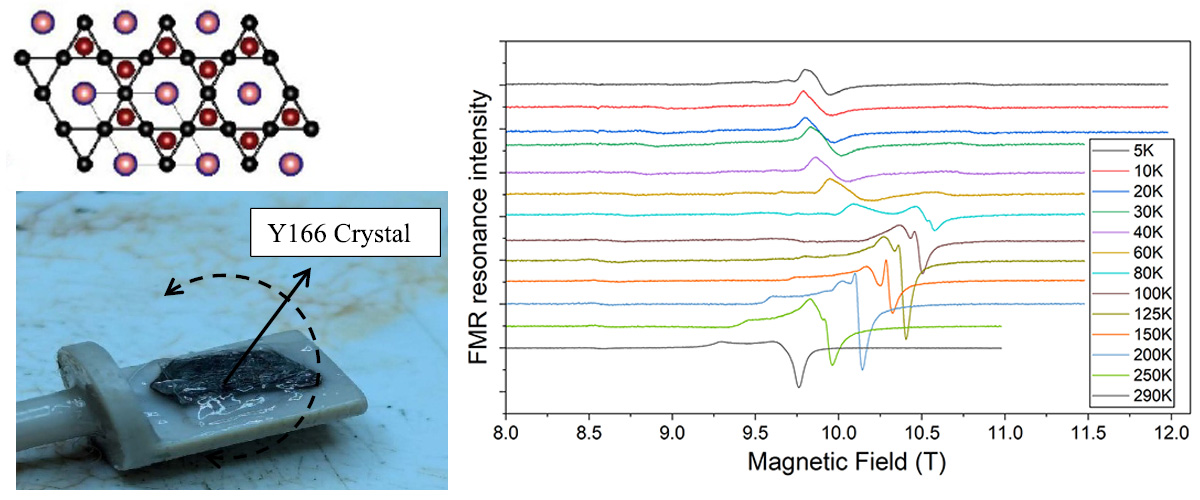
Researchers showed that a complex metallic material can be studied using magnetic resonance, even though metals are typically difficult to measure with this technique. The material, YMn6Sn6, changes its magnetic behavior depending on the strength of the applied magnetic field and temperature. The study shows that in certain transition regions, multiple magnetic states exist at the same time, revealed by overlapping resonance signals.
Why is this important?
This YMn6Sn6 material belongs to a family known as Kagome metals, which have a unique lattice structure resembling a woven pattern. This structure leads to unusual electronic and magnetic properties.(Fig 1 lower left). This material has a large anomalous thermoelectric effect. Understanding how these properties change under different conditions could enable new technologies, such as advanced energy conversion devices and next-generation electronics. Magnetic resonance measurements provide a detailed, local view of the magnetic behavior—offering insights that traditional bulk measurements cannot capture.
Who did the research?
Lovia Ofori1, Johan van Tol2, Nathan Tolva3, Hari Bhandari4, Nirmal Ghimire4, and Srinivasa Rao Singamaneni1
1University of Texas at EL Paso; 2National MagLab, FSU ; 3Boston College; 4University of Notre Dame
Why did they need the MagLab?
This research needed access to extremely high magnetic fields and specialized instruments to observe how the material’s magnetic behavior evolves. The National MagLab provides unique capabilities, including high-frequency measurements that allow scientists to probe the material under multiple conditions on the same sample. Using three different high frequencies on the same sample, the local field on the Mn ions could be probed in three different magnetic phases by (ferro)magnetic resonance. The instrumentation at the MagLab is unique able to provide this capability to outside users.
Details for scientists
- View or download the expert-level Science Highlight, Magnetic Resonance at High Fields in the Layered Magnetic Metal YMn6Sn6
- Read the full-length publication, High-frequency electron spin resonance in Kagome-Lattice YMn6Sn6, in Journal of Physics: Condensed Matter - Data Set - HF-EPR Data
Funding
This research was funded by the following grants: K. M. Amm (NSF DMR-2128556); S.R. Singamaneni (NSF DMR-2105109)
For more information, contact Johan Van Tol.