

What is the finding
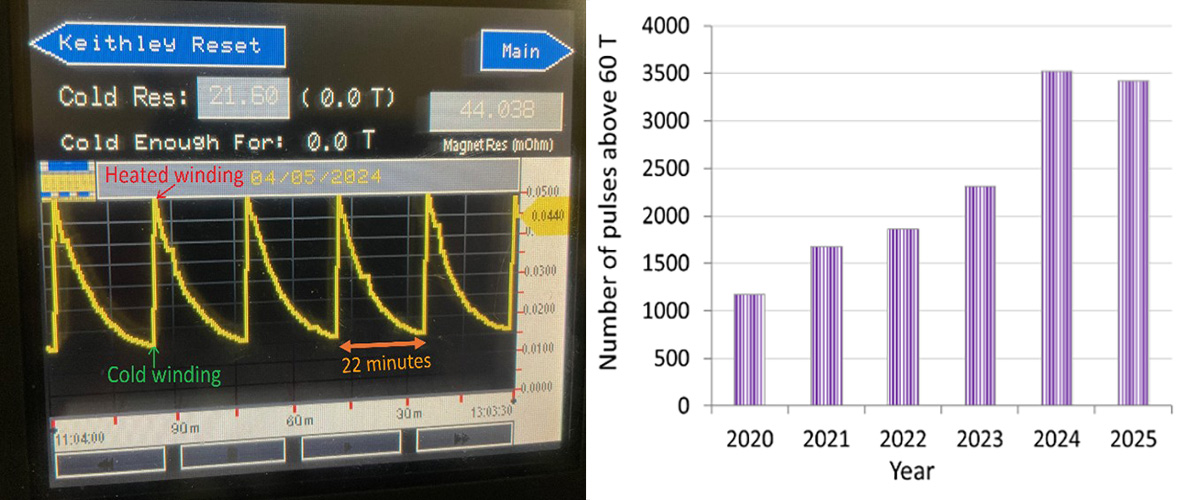
Scientists and engineers at the National High Magnetic Field Laboratory’s Los Alamos facility have significantly improved the performance of their pulsed magnet systems, which generate extremely strong magnetic fields for short periods of time. Combining an advanced mechanical design with improved, more cost-effective CuCrZr magnet wire significantly increases the magnets’ lifespan. The design also incorporates liquid-nitrogen cooling channels between component coils to significantly reduce the cooling time between pulses.
Why is this important?
Very high pulsed magnetic fields allow researchers to probe the materials in extreme conditions, revealing properties unseen at lower fields key for advances in quantum materials, energy technologies, and electronics. The 75-T duplex & 60-T mid-pulse magnets provide user access to pulsed magnetic fields with either higher peak amplitudes or longer pulse durations, supporting the needs of the user community. Since its commissioning, the 75-T duplex magnet has delivered ~1500 full-field pulses for users. The 60-T mid-pulse magnet has significant user interest because its pulse duration is about 300 ms—roughly five times longer than that of a standard 65-T magnet. The fast-cooling design substantially increased magnet productivity delivering approximately 3,500 pulses at or above 60 tesla, a 50% increase compared with the previous year.
Who did the research?
Doan Nguyen1, James Michel1, Scott Betts1, Jason Lucero1, Iain Dixon2, Rongmei Niu2 and Ke Han2
1National MagLab, Los alamos; 2National High Magnetic Field Laboratory, FSU
Why did they need the MagLab?
Producing and running the world’s strongest pulsed magnetic fields requires specialized infrastructure, engineering expertise, and experience that exist only at the National MagLab. The MagLab’s Los Alamos branch combines large capacitor banks, advanced magnet designs, and materials expertise to push pulsed-field technology forward. These improved cooling channels, stronger and more durable magnet wire, and refined mechanical designs are the result of sustained innovation at the MagLab & they enable user experiments unable to be performed anywhere else.
Details for scientists
- View or download the expert-level Science Highlight, Performance and Lifetime Improvements of Pulsed Magnets
- Read the full-length publication, Recent Magnet Developments at the Pulsed Field Facility (NHMFL) at Los Alamos, in IEEE Transactions on Applied Superconductivity
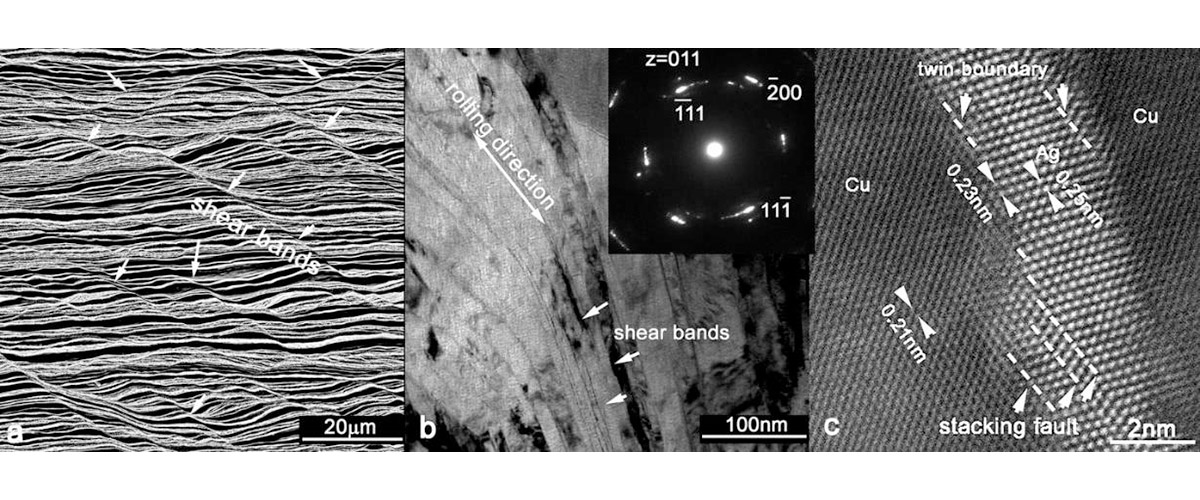
- Read the full-length publication, Notch tolerance of high-strength Cu-based nanocomposites, in Materials Characterization
Funding
This research was funded by the following grants: K. M. Amm (NSF DMR-2128556)
For more information, contact Neil Harrison.