

What is the finding
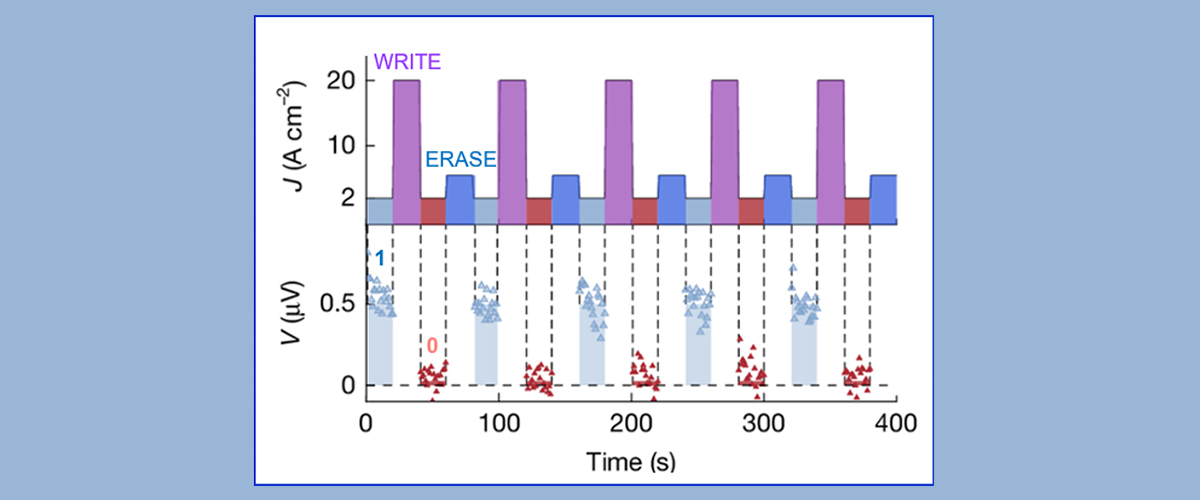
Researchers discovered that the superconducting material UTe2 can be switched between different memory states using electrical pulses while remaining superconducting. Once switched, the material retains its state for extended periods and can be reset using a different electrical signal.
Why is this important?
Memory is a fundamental building block of computing. This work demonstrates a new way to store information using the quantum properties of a superconductor itself. Because superconductors conduct electricity without resistance, similar devices could someday enable more energy-efficient computing systems, including cryogenic electronics and future quantum technologies. The discovery also reveals new physics associated with competing superconducting phases and how they can be controlled electrically.
Who did the research?
Zheyu Wu1,3, Hanyi Chen1, Mengmeng Long1, Daniel Shaffer2, Dmitry V. Chichinadze4, Andrej Cabala5, Theodore I. Weinberger1, Alexander J. Hickey1 et al.
1University of Cambridge; 2University of Wisconsin-Madison; 3National MagLab; 4Washington University in St. Louis; 5Charles University
The primary author of this publication is now the MagLab’s Jack E. Crow Postdoctoral Fellow.
Why did they need the MagLab?
The memory effect appears only in a narrow region where two superconducting phases coexist under very high magnetic fields and extremely low temperatures. The unique capabilities of the National High Magnetic Field Laboratory's DC Field Facility were essential for reaching this regime and mapping the phenomenon. Access to the lab’s high-field magnets and ultra-low-temperature infrastructure allowed researchers to identify and characterize the conditions under which the memory behavior emerges.
Details for scientists
- View or download the expert-level Science Highlight, Extreme Fields Reveal Superconducting Memory
- Read the full-length publication, Electrically controllable superconducting memory effect in UTe2, in Nature.
Funding
This research was funded by the following grants: K. M. Amm (NSF DMR-2128556); NSF DMR-1644779; NSF OMA-2016136; NSF (2201516); EP/X011992/1; EP/R513180/1; and others.
For more information, contact Julia Smith.