Contact: Zhehong Gan
TALLAHASSEE, Fla. — The late Rob Schurko, who lead the MagLab’s Nuclear Magnetic Resonance facility for six years, is being recognized posthumously for his pioneering work.
Schurko has been named recipient of the 2026 Eastern Analytical Symposium Award for Outstanding Achievements in Magnetic Resonance.
“An internationally recognized leader in solid-state NMR, Schurko pioneered ultra-wideline methods and pulse sequences that expand the study of challenging nuclei across the periodic table,” wrote the Symposium’s award committee. “His research has transformed applications in materials science, inorganic chemistry, and pharmaceuticals.”
Schurko died February 20, 2026, after a battle with pancreatic cancer. He was 55.
“Rob was an extraordinary leader of our NMR team, an exceptional scientist, and a truly remarkable human being,” said MagLab Director Kathleen Amm. “This honor, though bittersweet, is a testament to Rob’s impact on NMR research. We will accept this award on his behalf knowing that his legacy lives on through the many students and colleagues he taught, led, and inspired.”
“Rob has made several important contributions to the field of solid-state NMR,” said Rob’s colleague and acting NMR Program Director Zhehong Gan, “He developed WURST-CPMG pulse sequence for acquisition of ultra-wideline NMR spectra. He introduced BRAIN-CP method for enhancing the signals of many “unreceptive” nuclides across the periodic table. More recently he and Lucio Frydman, MagLab’s chief scientist in chemistry, demonstrated an innovative method called PROSPR which enables them to acquire unreceptive and dilute nuclides through sensitive and abundant nuclei like protons.”
Schurko authored more than 165 publications, delivered dozens of invited lectures and conference presentations worldwide, played leadership roles across the magnetic resonance community, and received numerous honors, including election as a Fellow of the International Society for Magnetic Resonance in 2025 and the 2023 Regitze R. Vold Memorial Prize for his important contributions to solid-state nuclear magnetic resonance over 25 years.
“We are very proud to see Rob among the pioneers and leaders in NMR research," said Dr. Wei Yang, Chair of the FSU Department of Chemistry and Biochemistry. "His selection for this award testifies to his leadership position in this intellectually competitive area. He will also be well remembered as a classy colleague, a passionate classroom teacher, and a thoughtful student mentor.”
Schurko joined Florida State University and the MagLab in 2019, becoming the lab’s Director of NMR in 2020. His pioneering work in solid‑state nuclear magnetic resonance opened up applications for medicine, nanoparticles, catalysts, and more. One of his recent projects, funded by the Department of Energy, was analysis of platinum group elements to better understand how those materials, critical to many technologies, form complex molecular structures.
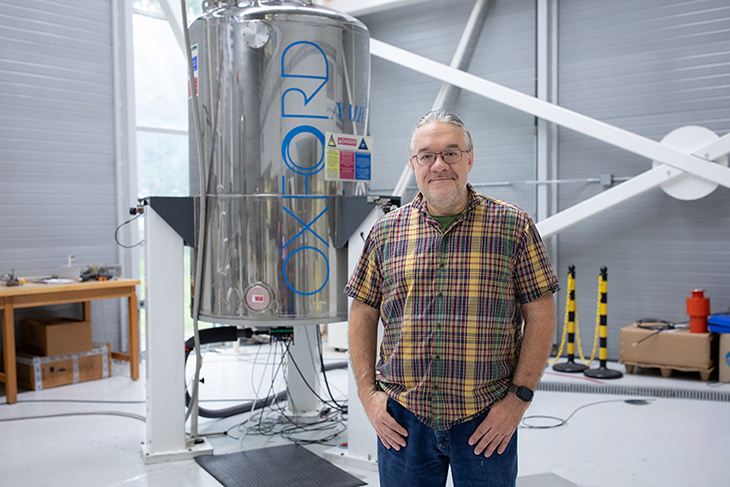
In this 2025 photo Rob Schurko stands in the MagLab’s NMR facility, which he directed from 2020 until his passing in 2026.
Photo credit: Devin Bittner, FSU College of Arts & Sciences
Born and raised in Winnipeg, Manitoba, Canada, Schurko obtained his bachelor’s and master’s degrees at the University of Manitoba and his Ph.D. at Dalhousie University. He conducted postdoctoral studies at SUNY, Stony Brook and University of Illinois, Chicago, then spent 19 years as a Professor of Chemistry at the University of Windsor, Canada prior to joining the MagLab.
Schurko was also acclaimed for his exceptional work as a teacher and mentor, engendering a passion for magnetic resonance research among his students, many of whom continued to work in the field in academic and industrial settings.
“Rob enjoyed not just doing science but also sharing science and knowledge with the people around him. He was a real teacher and scholar,” said Lucio Frydman, MagLab Chief Scientist in Chemistry and Biology who was also Schurko’s postdoc adviser at the University of Illinois, Chicago more than 25 years ago.
No matter the focus, Schurko embraced collaboration and showed great passion for the pioneering work happening in his lab.
“Solid-state NMR is helping us solve structures of pharmaceuticals, catalysts, and advanced materials that are too complex for conventional techniques. We are pushing the boundaries of what’s possible by building powerful new instruments and working side-by-side with users to answer questions that no one else can. That combination of technology, collaboration, and discovery is what keeps me excited every day,” Schurko said in a 2025 interview.
The Award for Outstanding Achievements in Magnetic Resonance will be presented November 17 at the Eastern Analytical Symposium in Plainsboro, NJ. The symposium is held each year “to provide professional scientists and students continuing education in the analytical and allied sciences through the presentation of symposia of papers, workshops, and short courses.”
Read the full award for outstanding achievements in magnetic resonance proclamation