Contact: Kristin Roberts
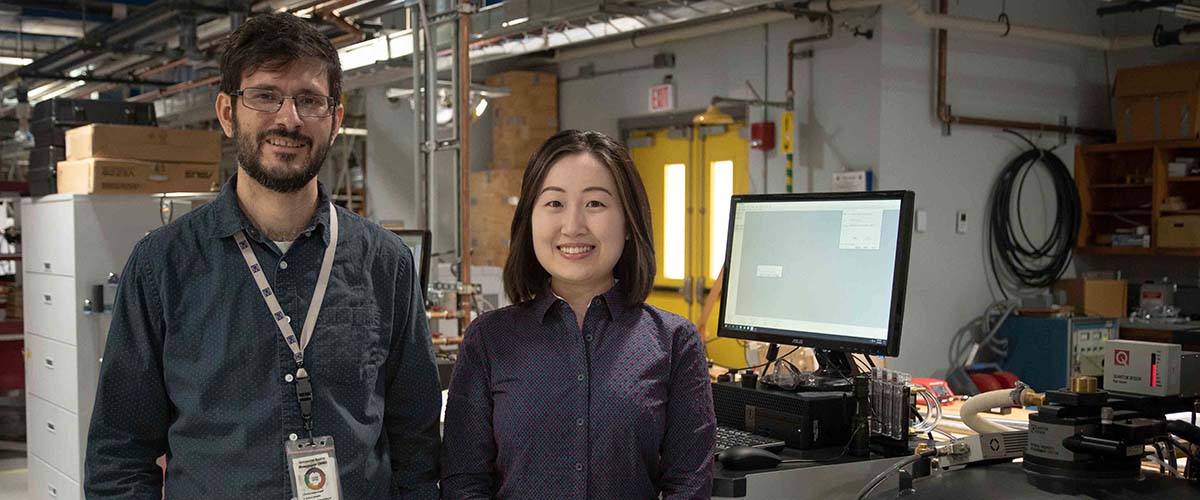
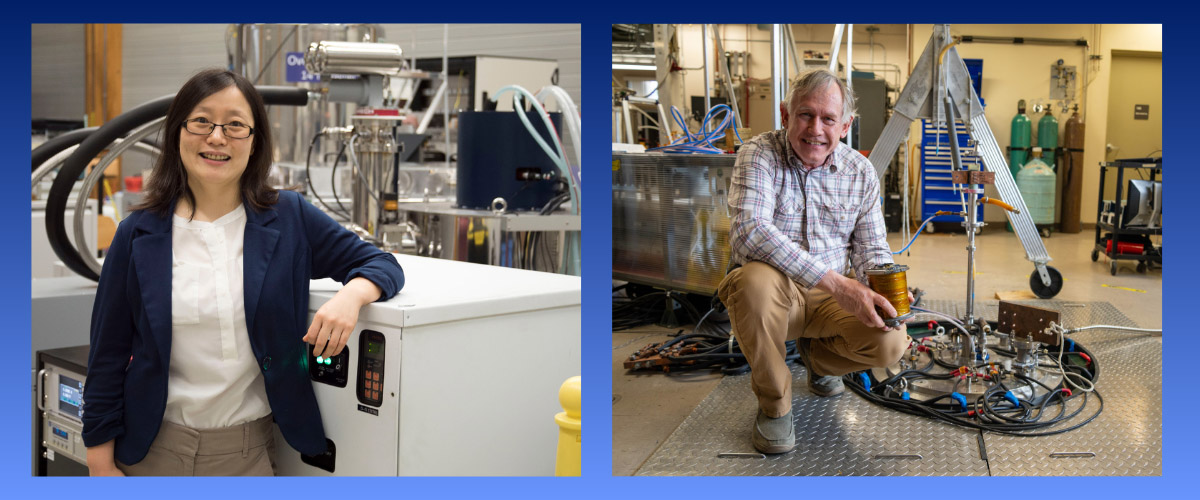
TALLAHASSEE, Fla. — Two MagLab researchers, Yan-Yan Hu and Ulf Trociewitz, have been named Senior Members in the National Academy of Inventors for their work developing technologies that impact the world.
“This recognition from the National Academy of Inventors is a testament to the inventiveness and impact of these faculty members,” said Florida State University Vice President for Research Stacey Patterson. “Their research is making positive change in the world, and I’m proud to celebrate their achievements.”
Hu is a MagLab nuclear magnetic resonance researcher and professor in the FSU Department of Chemistry and Biochemistry. Her work sits at the crossroads of chemistry, materials science and the MagLab’s world‑class capabilities.
Hu’s research is focused on advancing solid‑state NMR and MRI techniques to reveal how energy and biomaterials function at the atomic level. Her discoveries have reshaped understanding of ion transport and structure in solid‑state batteries and other energy‑storage materials, with results published in leading journals such as Nature Materials, Science Advances and Angewandte Chemie.
“I’m honored to receive this recognition and to be part of a community of amazing inventors driving transformative change in our society through technological innovation,” Hu said. “This recognition reflects the creativity and dedication of my students and collaborators, whose work has translated fundamental scientific insights into practical technologies.”
“I am particularly proud of our inventions in superionic conductors and mixed-anion materials,” explained Hu, “We introduced design concepts that leverage disrupted anion networks to enhance ion mobility. These discoveries have led to multiple patents and long-term collaborations with industry partners focused on next-generation solid-state batteries and energy storage technologies.”
Trociewitz is deputy director for magnet technology at the MagLab’s Applied Superconductivity Center. His research focuses on the development of high-temperature superconducting magnets and materials designed for ultra-high magnetic fields and exceptional homogeneity, particularly for nuclear magnetic resonance applications.
He holds six patents and has authored more than 80 peer-reviewed publications in international journals, reflecting his significant contributions to superconducting magnet innovation. His work supports the advancement of next-generation research instrumentation critical to scientific discovery in chemistry, biology and materials science.
Trociewitz leads a $1.2 million, four-year research project funded by the National Institute of General Medical Sciences to develop ultra-high-field NMR magnets using multifilament high-temperature superconductors. Through his research, Trociewitz continues to push the technological boundaries of magnet design, strengthening the nation’s leadership in advanced scientific infrastructure.
“This nomination provides an even greater visibility to a technology that is so important for a wide field of sciences and applications,” Trociewitz said. “I consider myself lucky to be able to work within a great team of people who are dedicated to advancing the frontiers of high temperature superconducting technology. Without them, none of this would be possible.”
Hu and Trociewitz are among 230 emerging inventors from around world in the NAI’s 2026 class of Senior Members. The group hails from 82 member institutions and collectively hold more than 2,000 patents. They join nearly 1,000 other Senior Members previously recognized by the National Academy of Inventors.
“This year’s Senior Member Class is a truly impressive cohort. These innovators come from a variety of fields and disciplines, translating their technologies into tangible impact,” said NAI President Paul R. Sanberg. “I commend them on their incredible pursuits and I’m honored to welcome them to the Academy.”
The Senior Member program was created to recognize active faculty, scientists, and administrators at NAI Member Institutions who have successfully produced, patented and commercialized technologies that have brought, or aspire to bring, real impact on the welfare of society and economic progress, according to the Academy.
View a full list of the 2026 Class of Senior Members here.
The 2026 class of Senior Members will be honored during the Senior Member Induction Ceremony at NAI’s 15th Annual Conference, June 1-4, 2026 in Los Angeles.