
Contact: Kristin Roberts
TALLAHASSEE, Fla. — There’s a new way to explore the world’s largest and highest-powered magnet laboratory, at any time and from anywhere. The National High Magnetic Field Laboratory has unveiled a comprehensive virtual tour of its Tallahassee, Fla. headquarters.
“If you can’t visit us in person, this is the next best way to experience our amazing lab,” said National MagLab Director Kathleen Amm. “It’s a fantastic look at our unique facility and the impactful research going on here every day.”
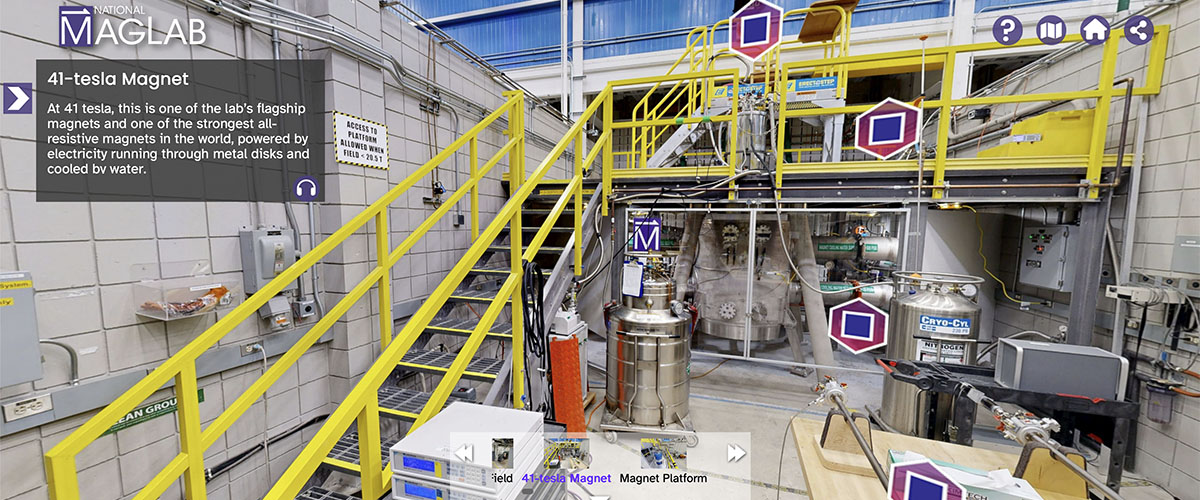
The new virtual tour, available via the MagLab website, provides immersive, 360° high-resolution views of dozens of lab spaces and nearly 150 hot spots with detailed information. Virtual visitors can learn more about the lab’s cutting-edge research, powerful magnets, and state-of-the-art equipment, from the smallest scale such as seeing individual atoms through an electron microscope, to the largest, like a subway-size tunnel of giant electrical switches that bring power to the magnets. The impressive images are best viewed on the larger screen of a desktop computer, but the tour is compatible for interactive smartphone viewing as well.
The virtual visit offers glimpses into many locations not normally open to the public, even during the lab’s popular annual Open House. Journey to the top of the three-story platform housing the flagship, 45-tesla world’s strongest magnet. Explore the electronics and machine shops where technicians build the lab’s unique equipment and instrumentation. Check out the system for recovering and recycling liquid helium to cool magnets. Even go inside and outside the lab’s extensive plant, where huge pipes, heat exchangers, water tanks, and cooling towers keep the magnets operating. The deep dive into the lab’s mission and operation includes pictures, graphics, videos, tutorials, and links for those who want to learn even more.
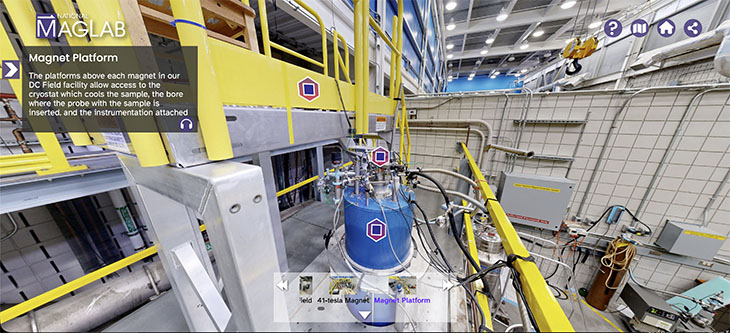
The view from the top of a magnet platform, a spot normally off limits to the public, as seen in the MagLab’s new virtual tour.
“We love to showcase our lab and share our passion for science. This virtual tour is a great new way to reach a wide audience, here in our local community and across the country,” said Kristin Roberts, MagLab Director of Public Affairs and Strategic Communications. “We’re supported by the public through the U.S. National Science Foundation and the state of Florida, so this lab belongs to everyone.”
The U.S. National Science Foundation funds the lab as a user facility, allowing scientists from across the country to access one-of-a-kind magnets, instrumentation, and expertise for research in physics, chemistry, biology, and beyond.
The virtual tour project was led by MagLab webmaster Nilubon Tabtimtong. Photographer/videographer Stephen Bilenky curated visuals including the high-resolution 360° images. Scientists, engineers, technicians and other personnel crafted accessible, engaging, and informative content about lab spaces and facilities.
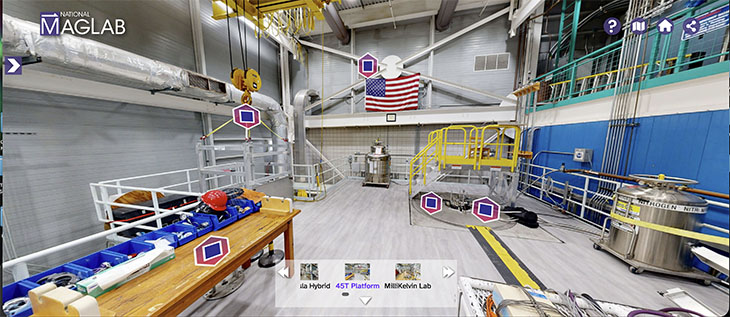
The view from the virtual tour at the top of the lab’s flagship 45-tesla hybrid magnet, the strongest magnet in the world.
The virtual tour is just the latest product in an expansive MagLab portfolio of public outreach. The lab’s Open House, a 30-year tradition that draws eight- to ten-thousand people, has been recognized by the NSF as a model of excellence. The lab’s monthly public tours have attracted people from around the world and draw hundreds of people a year. Education programs engage students through regular field trips, summer camps, and internships. Science Nights offer reading and hands-on activities for young students at the public library every month. And the lab’s YouTube channel and Magnet Academy website have dozens of videos, tutorials, and science lessons with tens of millions of views.
The National MagLab is headquartered at Florida State University, with satellite sites at the University of Florida in Gainesville and Los Alamos National Laboratory in New Mexico. Research areas include developing the materials of tomorrow for smaller, stronger, faster electronics and quantum computing, building more efficient energy systems, creating cleaner-burning fuels, uncovering new disease treatments, and investigating the mysteries of the universe.