

What is the finding
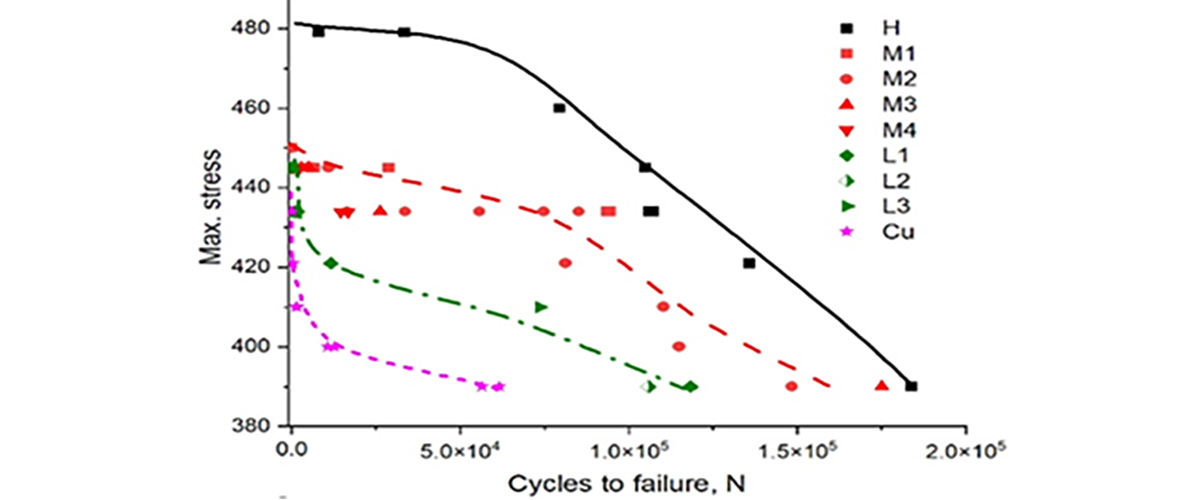
Researchers found that copper-zirconium (Cu-Zr) sheets last much longer under repeated stress than pure copper sheets, even when the copper is slightly stronger in standard strength tests. Both samples had been cold rolled, or processed at room temperature to increase the strength. In one comparison, a Cu-Zr sample survived about twice as many stress cycles as pure copper before failing. The results show that Cu-Zr is a better choice for building long-lasting resistive magnets and that stronger Cu-Zr materials generally have longer fatigue lives.
Why is this important?
Copper-based composites are widely used in applications that require high mechanical strength and electrical conductivity like resistive magnets. However, magnets experience repeated mechanical stresses during operation, which can eventually cause materials to wear out and fail. While these composites have been studied extensively, fatigue behavior of cold-rolled Cu-Zr sheets remains underexplored, especially under stress-controlled conditions that mimic magnet operational stresses. This work helps scientists better understand how Cu-Zr materials hold up under those real-world conditions and can guide the design of more durable magnets with longer operating lifetimes, reducing maintenance and improving reliability for users.
Who did the research?
R. Niu1, V. J. Toplosky1, J. Toth1, and K. Han1,
1National MagLab, FSU
Why did they need the MagLab?
The MagLab has unique expertise and facilities for evaluating materials used in high-field magnets. Its metallurgists and materials scientists specialize in studying conductor materials from many different perspectives, including strength, durability, and performance. This combination of advanced testing capabilities and deep materials knowledge made the MagLab an ideal place to determine how Cu-Zr conductors perform under the demanding conditions experienced inside powerful magnets.
Details for scientists
- View or download the expert-level Science Highlight, Fatigue Properties of Cold-Rolled Cu-Zr Alloy Sheets
- Read the full-length publication, Fatigue Properties of Cold-Rolled Cu-Zr Alloy Sheets, in IEEE Transactions on Applied Superconductivity
Funding
This research was funded by the following grants: K. M. Amm (NSF DMR-2128556)
For more information, contact Tom Painter.