

What is the finding
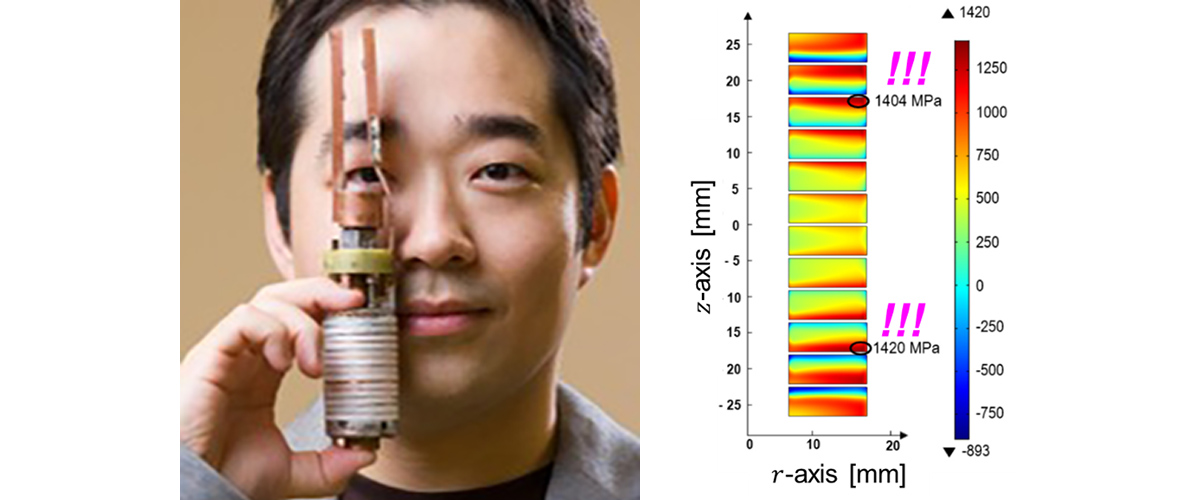
A tiny test coil named LBC9 generated 48.7 Tesla, blowing past its predecessor LBC3 (45.5 Tesla) to establish a new world record field and lay the groundwork for ultra-high-field superconducting magnets of greater than 50 Tesla.
Why is this important?
Scientists believe that superconducting electromagnets built using a rare-earth compound called “REBCO” can generate magnetic fields over 50 Tesla—in theory. But REBCO is a ceramic tape that cracks as easily as a coffee mug, is hard to manufacture and has properties that are often unpredictable. Designing a magnet that can withstand the huge electromagnetic stresses of operating at 50 Tesla is a challenge, but magnets of this field strength would have huge societal applications in MRI, particle accelerators, and fusion power plants.
Who did the research?
Jeseok Bang, Jonathan Lee, Garfield Murphy, Cade Watson, Kwangmin Kim, Rastislav Ries, Aixia Xu, Anatolii Polyanskii, Dmytro Abraimov, Najib Cheggour, Fumitake Kametani, David Larbalestier
National High Magnetic Field Laboratory, Florida State University
Why did they need the MagLab?
The MagLab’s Little Big Coils (LBCs) - ultra-compact magnets about the size of a soda can - are designed in house with the lab’s magnet engineering experts. Designed using small amounts of REBCO tape itself, the coil undergoes comprehensive materials characterization at the MagLab’s Applied Superconductivity Center (ASC). The coils also leverage the MagLab’s world unique infrastructure when they get placed inside a very high field background magnet of 31 Tesla. The little coil is charged to its limit, so far up to another 17.7 Tesla - putting the superconducting tape under ultra-high electromagnetic stress about 3200x higher than your car tires pressure. This unique setup allows researchers to push REBCO to its breaking point, gather critical data, and provide feedback to manufacturers—accelerating progress toward next-generation magnets.
Details for scientists
- View or download the expert-level Science Highlight, ‘Little Big Coil:’ A Skunkworks Program for >50 T Superconducting Magnets
- Read the full-length publication, Lengthwise Characterizations of Crystallographic Tilt in Contemporary REBCO Coated Conductors, in IEEE Transactions on Applied Superconductivity
Funding
This research was funded by the following grants: K. Amm (NSF DMR-2128556); D. Larbalestier (US DOE DE-SC0022011) and the State of Florida
For more information, contact David Larbalestier.