

What is the finding
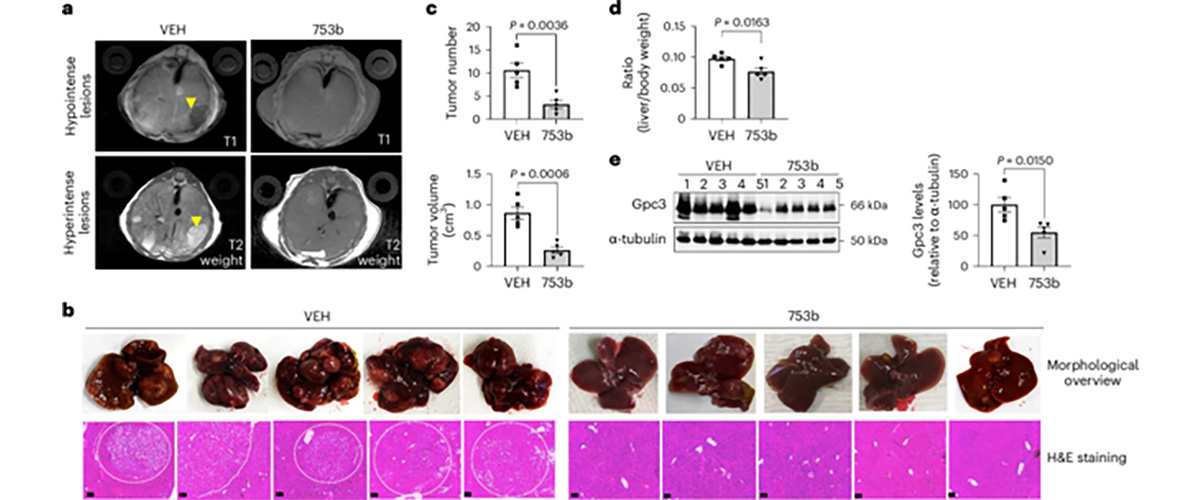
A group of scientists at University of Texas Health Science Center, University of Florida, and University of Tulane developed a compound (753b) that can target senescent (aging or deteriorating) cells in the liver. With MRI on mice and mouse models, they demonstrated that 753b slowed metabolic liver disease progression and may prevent the development of liver cancer, even in advanced disease stages. Imaging showed that the senescent cells (SnCs) were reduced in the livers of both aged mice and a mouse model (STAM) for metabolic dysfunction-associated steatohepatitis (MASH), metabolic dysfunction-associated steatotic liver disease (MASLD), liver fibrosis, and hepatocellular carcinoma. Importantly, 753b treatment could effectively slow the progression of MASLD and ultimately prevent the development of hepatocellular carcinoma (HCC) in STAM mice, even after the mice developed substantial metabolic dysfunction-associated steatohepatitis (MASH) and hepatic fibrosis.
Why is this important?
Liver disease impacts more than a billion people worldwide and MASLD is a fast-growing chronic liver disease affecting 25–30% of the population in Western countries. Disease progression studies suggest that the accumulation of deteriorating (senescent) cells may play a critical role in the induction and progression of MASLD. This new compound could become a therapeutic for these liver diseases.
Who did the research?
Yang Yang1,2, Natacha Jn-Simon3, Yonghan He2, Chunbao Sun3, Peiyi Zhang2, Wanyi Hu2, Tian Tian3, Huadong Zeng2, Sreenivasulu Basha3, Araceli S. Huerta1, Lu-Zhe Sun1, Xian-Ming Yin3, Robert Hromas1, Guangrong Zheng2, Liya Pi3, Daohong Zhou1,2
1University of Texas Health Science Center; 2University of Florida; 3Tulane University
Why did they need the MagLab?
High-field MRI at the MagLab allowed scientists to non-invasively track liver changes throughout the lifespan of the mice, providing quantitative measures of how effective 753b was in preventing the development of fibrotic lesions and ultimately tumor formation with exceptionally high resolution. High field MRI was critical for validating 753b’s impact and effectiveness.
Details for scientists
- View or download the expert-level Science Highlight, Targeting deteriorating cells to improve function and prevent cancer in a mouse model of liver failure
- Read the full-length publication, Evidence for a topological excitonic insulator in InAs/GaSb bilayers, in Nature
Funding
This research was funded by the following grants: K. Amm (NSF DMR-2128556); G. Zheng. and D. Zhou (NIH R01 AG063801, NIH R01 CA242003 ), L. Pi (NIH R01 AA028035)
For more information, contact Joanna Long.