
What is the finding
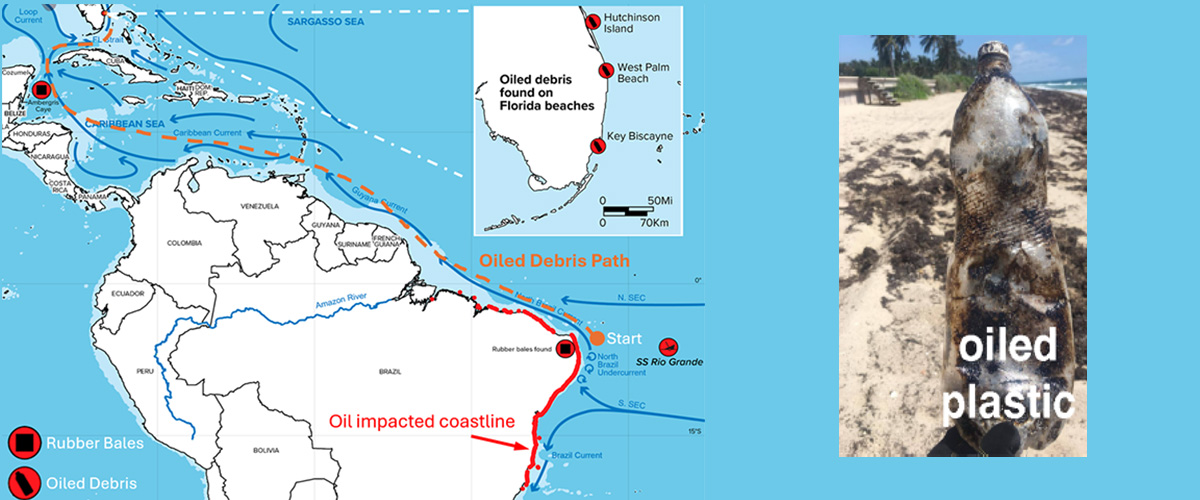
In late May through September 2020, the Friends of Palm Beach, a nonprofit organization dedicated to cleaning the coastline of Palm Beach, FL, noticed an unusually large quantity of capped glass and plastic bottles partially or fully covered with black residue. The black residues ranged from thin coatings to several millimeters thick. When present and legible, the labels on the bottles were written in Portuguese, Spanish, or English, mainly originating from South America / Caribbean countries. The molecular “fingerprint” of the black residues scraped from the Palm Beach, FL bottles matched that of a mystery oil spill that affected ~3000 km of Brazilian shorelines a year earlier.
Why is this important?
The study was the first to demonstrate how the growing amounts of ocean litter can transport contaminants great distances across the planet. In this case, an oil spill off the coast of Brazil delivered oil coated plastic and glass bottles to the shores of South Florida, an 8500 km journey, via ocean currents. The volume of ocean trash has reached the point that contaminants from one country can reach other countries thousands of miles away.
Who did the research?
Bryan D. James, Luis E. A. Bezerra, Diane Buhler, Rivelino M. Cavalcante, Martha L. Aguilera, Bing Chen, Jonas Gros, Ulrich M. Hanke, Karin L. Lemkau, Robert K. Nelson, Sydney F. Niles, André H. B. de Oliveira, Thomas D. Pitchford, Jagoš R. Radović, Ryan P. Rodgers, Marcelo O. Soares, Scott A. Socolofsky, Roger E. Summons, Robert F. Swarthout, Carlos E. P. Teixeira, David L. Valentine, Helen K. White, Min Yang, Eliete Zanardi-Lamardo, Baiyu Zhang, and Christopher M. Reddy
Author affiliations and complete funding list: https://pubmed.ncbi.nlm.nih.gov/41498408/
Why did they need the MagLab?
Because the oil coated plastic debris was at sea for nearly a year before reaching the beaches of South Florida, the volatile species had evaporated, and the remaining oil was sunbaked (photo-oxidized). Conventional oil spill forensic methods analyze the volatile fraction of the oil, those species that boil at temperatures below 400°C. Since there was very little of that material remaining, the high magnetic field mass spectrometers at the MagLab were needed to positively match the oil in Florida to the Brazilian spill.
Details for scientists
- View or download the expert-level Science Highlight, Long-Range Transport of Oil by Marine Plastic Debris: An 8500 km Journey
- Read the full-length publication, Long-Range Transport of Oil by Marine Plastic Debris: Evidence from an 8500 km Journey, in Environmental Science and Technology
Funding
This research was funded by the following grants: K. M. Amm (NSF DMR-2128556); Christopher M. Reddy (NSF OCE 1756242 and WHOI Independent R&D Program)
For more information, contact Kristina Hakansson.