

What is the finding
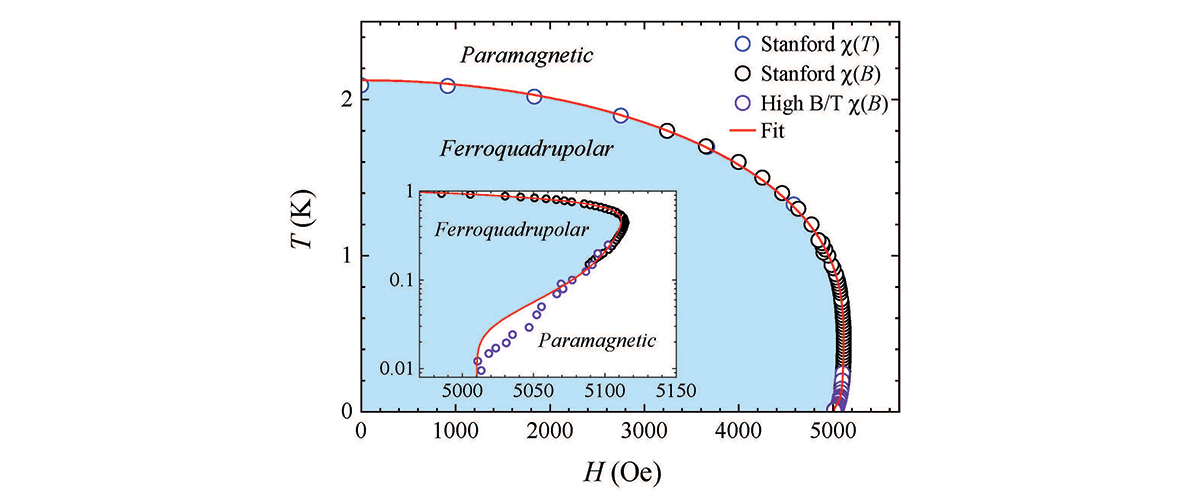
Scientists from Stanford University studied a special magnetic material called TmVO4. To fully understand how it behaves, they needed to cool it to temperatures extremely close to absolute zero. Working with researchers at the MagLab’s High B/T Facility, they collected data at ultralow temperatures that were critical in unambiguously identifying that the material’s behavior can only be explained if interactions between electrons and atomic nuclei are included. These interactions are often ignored in theoretical and numerical models, but this study shows they matter.
Why is this important?
Some materials can change their internal state through a quantum phase transition when factors like magnetic field, pressure, or chemical makeup are adjusted. Scientists adjust these factors to better understand quantum materials, including magnets and superconductors. This research shows that quantum phase transitions can also be controlled by very subtle interactions between electrons and nuclei. Demonstrating this new way of tuning quantum behavior expands our understanding of phase transitions and provides deeper insight into the fundamental properties of quantum materials.
Who did the research?
Mark P. Zic1, Chao Huan2, Nicolas Silva2, Yuntian Li1, Mark W. Meisel2, Ian R. Fisher1
1Stanford University; 2National MagLab High B/T Facility and University of Florida
Why did they need the MagLab?
At very low temperatures, random motion inside a material drops dramatically. Each tenfold drop in temperature reduces this background “noise” by about a thousand times. With so much less interference, researchers can observe delicate quantum effects that are normally hidden. Achieving such extreme conditions requires highly specialized equipment, available only at the National High Magnetic Field Laboratory’s High B/T Facility
Details for scientists
- View or download the expert-level Science Highlight, Electro-nuclear quantum phase transition in TmVO4
- Read the full-length publication, Electro-nuclear quantum phase transition in TmVO4, in arXiv:2509.11489
Funding
This research was funded by the following grants: K. M. Amm (NSF DMR-2128556); M. P. Zic ( NSF DGE-1656518); I. R. Fisher (AROSR FA9550-20-1-0252, FA9550-24-1-0357, FA 9550-22-1-084)
For more information, contact Mark Meisel.