

What is the finding
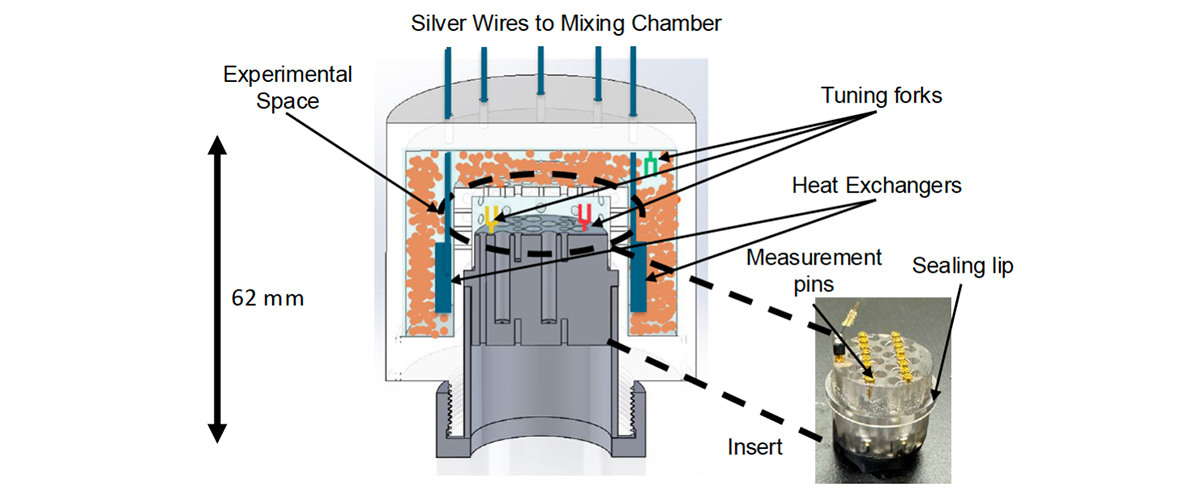
Researchers developed a compact “in-cell” magnetic cooling device that can be installed inside a standard cryogen-free cryostat. The system cooled electrons in quantum devices to as low as 2 mK, only a tiny fraction of a degree above absolute zero, and maintained temperatures below 5 mK for extended periods while operating in magnetic fields up to 14 tesla within a standard cryogen‑free cryostat using only 66g of copper powder in liquid3He.
Why is this important?
The compact, plug‑and‑play magnetic refrigerator delivers sub‑10 millikelvin temperatures inside a standard cryogen‑free cryostat, enabling researchers to probe exotic quantum phases in graphene, GaAs, and other nanostructures in the presence of a strong magnetic field. Since the design fits into existing platforms, it lowers infrastructure costs and accelerates time‑to‑experiment, paving the way for scalable quantum‑device development. This advance in cooling will improve the study of subtle quantum responses, ultimately providing pathways to longer quantum coherence times across a wider, more accessible range of temperatures and fields.
Who did the research?
Alexander M. Donald1, Nicolas Silva1, Christopher J. Ollmann1, Roch Schanen2, Chao Huan1, Sangyun Lee1, Dominique Laroche1, Richard P. Haley2, Mark W. Meisel1, Rasul Gazizulin1
1National High Magnetic Field Laboratory High B/T Facility and University of Florida; 2Lancaster University, UK
Why did they need the MagLab?
The MagLab High B/T Facility supplies the simultaneous high magnetic field and ultralow‑temperature environment that makes efficient demagnetization cooling possible, a key requirement for reaching sub‑5 mK temperatures while a sizable magnetic field is present.. The facility also provides the specialized cryogenic infrastructure and exceptionally low electrical noise environment needed for these highly sensitive measurements, resources that are not typically available at universities or other home institutions.
Details for scientists
- View or download the expert-level Science Highlight, New Cooling Device Reaches Record-Low Temperatures for Quantum Research
- Read the full-length publication, Sub-10 mK "in-cell' magnetic refrigeration for cryogen-free cryostats, in Review of Scientific Instruments
Funding
This research was funded by the following grants: G.S. Boebinger (NSF DMR-1644779) and K. M. Amm (NSF DMR-2128556)
For more information, contact Mark Meisel.
![(Left) 125Te spectral line and effective gamma with respect to magnetic field. Black circles are from the 36T Series Connected Hybrid while the pink diamonds are from the new HTS 32T magnet. (Right) Phase diagram for H//c highlighting the possible spin-nematic state. [PRB 94 064403 2016] Solid circles are from magnetostriction. Open circles from magnetostriction and thermal expansion. Open triangles from magnetization.](/media/z0nigcdk/jan2021_dc_field_probing_spin_nematic_state.jpg)