
What is the finding
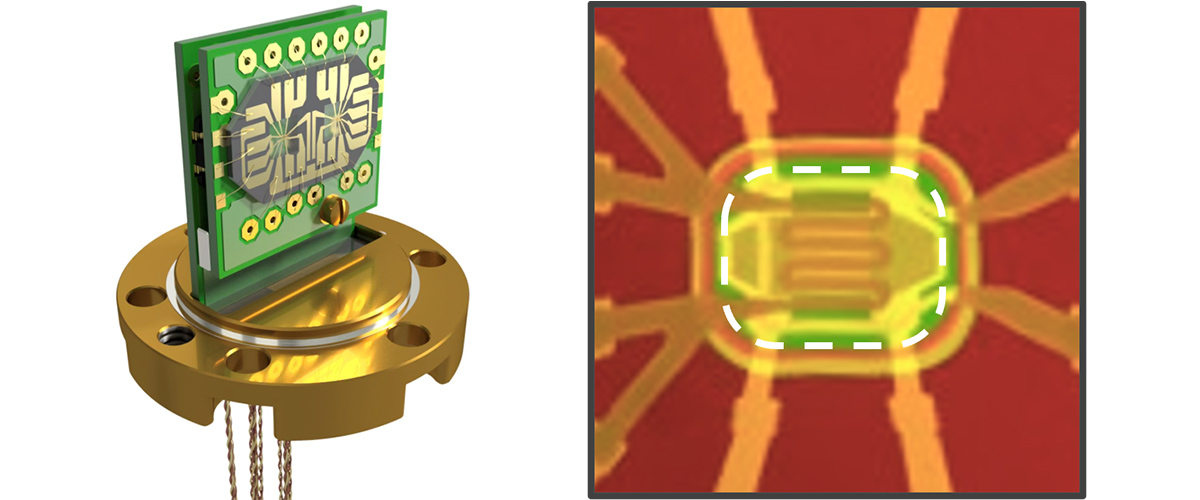
Scientists discovered that an electrical insulator, YbB12, contains hidden particles that respond to magnetic fields even though they carry no electric charge. These “neutral fermions” revealed themselves through tiny ripples in the heat capacity when the material was placed in very strong magnetic fields.
Why is this important?
An insulator behaving like a metal is not expected, challenging long-standing ideas about how electrons behave in solids. Understanding these unusual particles may help scientists develop new theories for quantum materials. In the long term, insights from these systems could contribute to new technologies in electronics, sensing, and quantum information.
Who did the research?
Kuan-Wen Chen1,; Yuan Zhu1,; Danilo Ratkovski2; Guoxin Zheng1; Dechen Zhang1; Aaron Chan1; Kaila Jenkins1; Joanna Blawat3; Tomoya Asaba4; Fumitoshi Iga5; Chandra M. Varma6; Yuji Matsuda4,7; John Singleton3; Alimamy F. Bangura2; Lu Li1
1University of Michigan, 2National MagLab, FSU. 3National MagLab, LANL, 4Kyoto University, 5Ibaraki University, 6University of California, Riverside, 7Los Alamos National Laboratory
Why did they need the MagLab?
Detecting these extremely small heat-capacity signals requires both very strong, stable magnetic fields and highly sensitive calorimetry. The MagLab’s DC-Field Facility is the only place where continuous magnetic fields above 35 tesla can be combined with precision nanocalorimetry—making this discovery possible. The MagLab’s unique environments allow scientists to uncover hidden states of matter that cannot be seen anywhere else.
Details for scientists
- View or download the expert-level Science Highlight, Neutral Fermions Revealed by High-Field Heat Capacity in a Kondo Insulator
- Read the full-length publication, Quantum Oscillations in the Heat Capacity of Kondo Insulator YbB12, in Physical Review Letters
Funding
This research was funded by the following grants: K. M. Amm (NSF DMR-2128556); (NSF DMR-2317618; DOE DE-SC0020184; DOE BES “Science at 100 T”; Gordon and Betty Moore Foundation GBMF5305; JSPS KAKENHI 23H00089; JST CREST JPMJCR19T5)
For more information, contact Alimamy Bangura.