
What is the finding
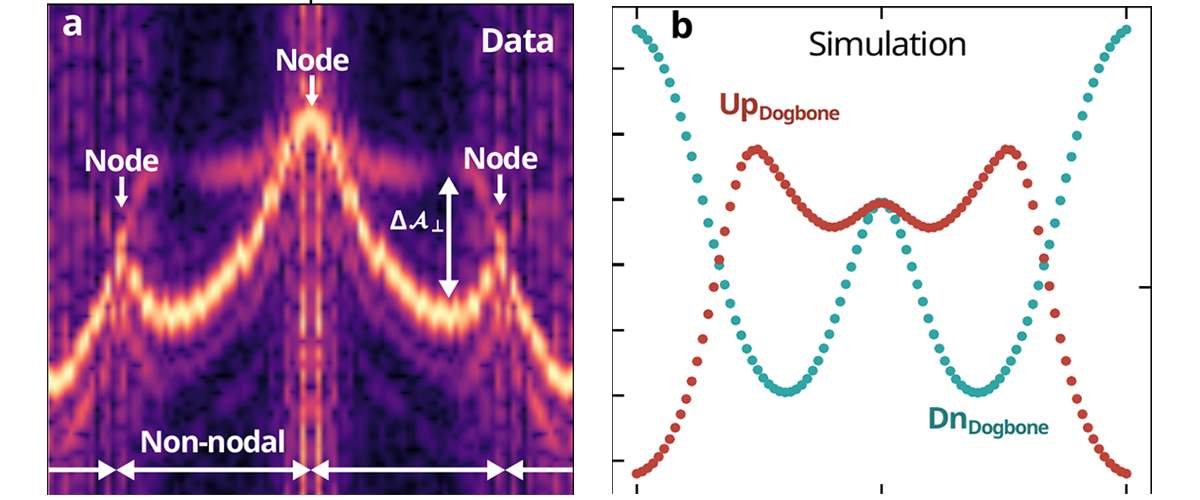
Researchers from the University of Cambridge and the MagLab found a brand-new kind of magnetism inside a crystal of chromium antimonide (CrSb). In this state — "altermagnetism" — the tiny atomic magnets cancel out exactly, so the material gives off no magnetic field of its own. Yet the electrons moving through the crystal separate into two streams, sorted by a quantum property called "spin." When the researchers mapped how the electrons flow, those streams traced a distinctive, never-before-seen pattern.
Why is this important?
This is the first time scientists have firmly shown that altermagnetism exists deep inside the "bulk" — the interior — of a metal. This discovery matters for future computing because (1) with no magnetic field, these materials won't accidentally erase or disturb nearby electronics; (2) the two electron streams could encode and store information and (3) most importantly, they keep working at temperatures well above room temperature.
Who did the research?
M. Long1, T. Weinberger1, Z. Wu1,2, M. Hansen1, R. Tao1, M. Shrestha1, D. Graf2, Y. Skourski3, M. Grosche1, A. Eaton1
1University of Cambridge, Cambridge, UK; 2MagLab, Tallahassee FL, US; 3HLD-EMFL, Dresden, Germany
Why did they need the MagLab?
This hidden pattern is invisible to ordinary microscopes and appears only in extremely strong magnetic fields. The team came to the DC Field Facility of the National High Magnetic Field Laboratory (MagLab) in Tallahassee, Florida. They used the world's strongest continuous magnet — 41.5 tesla, about 800,000 times Earth's magnetic field — to test the crystal. With the MagLab's support and an ultra-sensitive detector, the scientists tracked the tiny, fast-moving electrons inside the crystal and confirmed the theory.
Details for scientists
- View or download the expert-level Science Highlight, CrSb Reveals a Novel 3D Magnetic Order
- Read the full-length publication, 3D bulk-resolved g-wave magnetic order parameter symmetry in the metallic altermagnet CrSb, in Nature.
Funding
This research was funded by the following grants: NSF DMR-1644779/2128556, OISE-2201516; State of Florida; UKRI EP/Z533695/1, EP/R513180/1; GBMF9616
For more information, contact Alimamy Bangura.