
Contact: Ryan Rodgers
TALLAHASSEE, Fla. —
Ocean litter has long been a crisis and is only worsening, projected to triple over the next fifteen years.
The debris threatens marine life, damages coral reefs, and leaks microplastics into the environment.
Now, new research from collaborators across the Western Hemisphere including the MagLab shows another harmful impact. A paper published in The American Chemical Society’s Environmental Science & Technology documents how litter tossed in the ocean can deliver other pollution to shores thousands of miles away.
The story starts in Brazil, where in the summer and fall of 2019, environmental groups, scientists, and government officials were alarmed as an estimated 100 tons of oil washed ashore. Black sludge marred more than 1800 miles of Brazil’s northeastern coastline-- equivalent to the distance from Key West, Florida to Bar Harbor, Maine. No one knew where it was coming from.
Chemical oceanographer Christopher Reddy at Woods Hole Oceanographic Institution in Massachusetts, a leading expert on oil spills who’s studied them for 30 years, worked with colleagues in Brazil to try to pinpoint the source. For help, they turned to longtime collaborators at the MagLab, who offer unparalleled chemical analysis of petroleum.
“The MagLab can see the tiniest details in a complex mixture of pollutants, like crude oil or other petroleum products, that traditional platforms can’t see,” said Reddy. “The unique chemical information provided by the Mag Lab helps us identify sources, compare if two samples are the same or not, and how long a sample has been in the environment.”
For decades, the MagLab’s Ion Cyclotron Resonance facility has lead the world in petroleomics, sorting and characterizing the tens of thousands of unique molecules found in a drop of oil. The team developed a detailed profile of the spilled oil but never could determine the source, which to this day remains a mystery.
“It’s almost like we had some DNA or fingerprints from the event, but there’s no reference to compare them to,” Reddy explained.
But those fingerprints would come in handy about a year later when Reddy learned of another mystery out of Palm Beach, Florida, where a team of dedicated volunteers known as Friends of Palm Beach walks the shoreline every day to pick up beach litter.
“They started to notice an unusually large amount of oil-covered debris in late May 2020, something very new to the Friends of Palm Beach,” Reddy said.
The oily debris kept coming throughout the summer of 2020. At its peak in June and July, beach combers were finding 10 to 12 items every day coated in black residue. Curiously, labels on many of the bottles and cans were in Spanish and Portuguese. Based on his knowledge of ocean currents, Reddy immediately thought of the spill in Brazil.
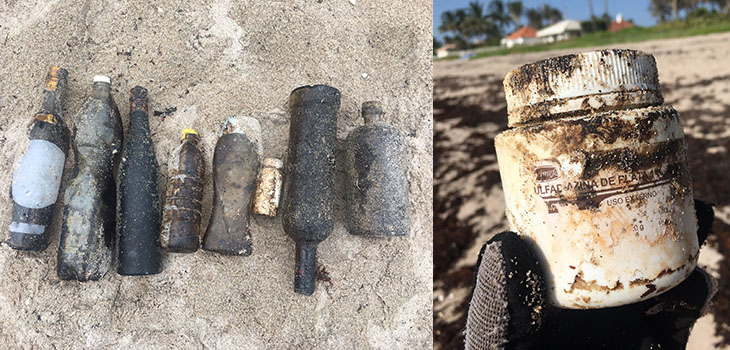
Oil-soaked debris found along the beach in southeast Florida in summer 2020 (Friends of Palm Beach).
“There were studies done in the 1960s where Brazilian scientists were taking little messages in a bottle… those bottles showed up eight months later in Southeast Florida. The oceanography component had me pretty strongly convinced even before the samples arrived.”
Gas chromatography of the Palm Beach litter in his lab at Woods Hole confirmed Reddy’s suspicion. The profile seemed to match the Brazilian oil spill. But it wasn’t enough to be certain. The researchers wanted to rule out another possible culprit— oil that naturally seeps out of the seafloor and bubbles to the surface.
“The first thing that anybody would say is there is so much oil floating around in the Gulf that those bottles, one way or the other, just picked up some of that.”
That’s when Reddy again turned to the MagLab’s Ion Cyclotron Resonance team for more detailed analysis.
“They were able to answer a question that we couldn't answer, and it was absolutely critical to the story, and that was, could we discount all the naturally seeped oil in the Gulf as a potential source?” Reddy said.
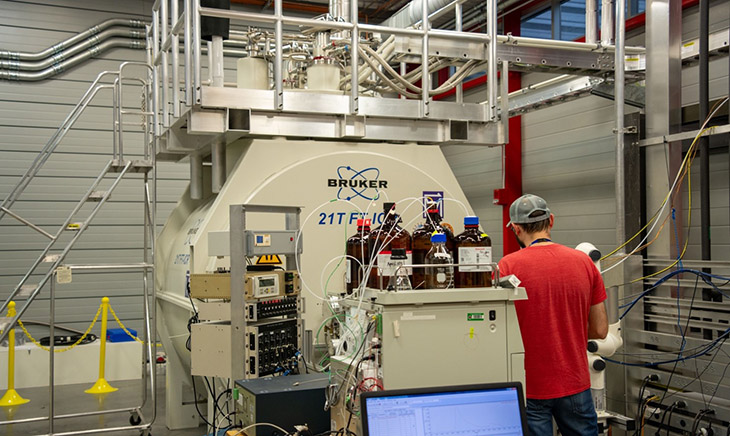
The MagLab’s 21-tesla Ion Cyclotron Resonance magnet, the most powerful mass spectrometer in the world.
The MagLab’s chemical profile indicated the oil had been refined, ruling out the possibility of natural seepage. The work also confirmed that the oil’s fingerprint matched the spill in Brazil.
“To have such a complex mixture be consistent between two samples is highly unlikely, which is why the confidence is high, because the number of components that you're monitoring in the oil is huge. It's tens of thousands. It's not 10 or 15,” said Ryan Rodgers, Deputy Director of the MagLab’s ICR Facility, petrochemical researcher and longtime collaborator with Reddy.
While the chemical analysis checked out, the team also brought in collaborators specializing in ocean currents. They simulated trajectories and timelines for debris to float from the Brazilian coast to southeast Florida, five thousand miles away. The direction and drift of the currents corroborated their theory. The model estimated a total travel time of approximately 240 days, which also matches. All the evidence lined up.
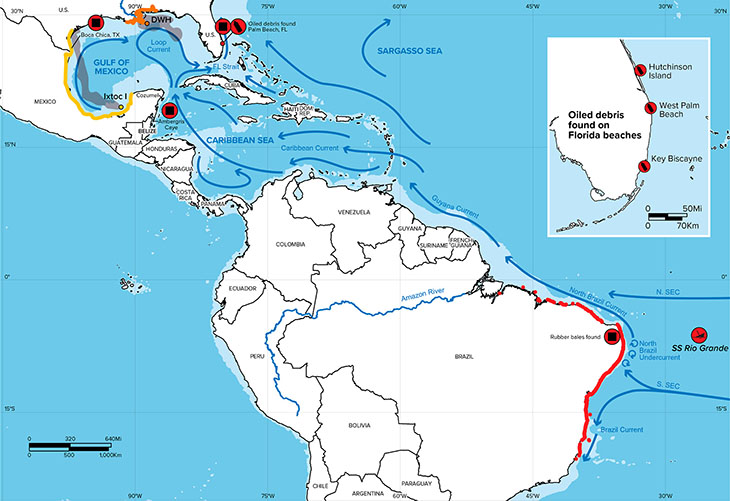
A map of ocean currents along the coast of Brazil through the Caribbean and Gulf to Florida and the locations where oiled debris was found.
“The ocean, in this case, unfortunately provided a means to transport oil and debris over very long distances. It's a reminder that the activities we do in our backyard can be felt in someone else's backyard far away,” said Reddy.
Oil slicks usually float only about 200 miles before winds, waves, and turbulence disperse them. The research shows how other ocean pollutants can be transported over long distances, spreading contamination far and wide.
“The pollution that you have coming into your country, your state may not be your pollution,” Rodgers said. “If it's traveling on marine debris, it could be coming from all over the world. It’s sort of an eye-opening moment for the scientific community and the public.”
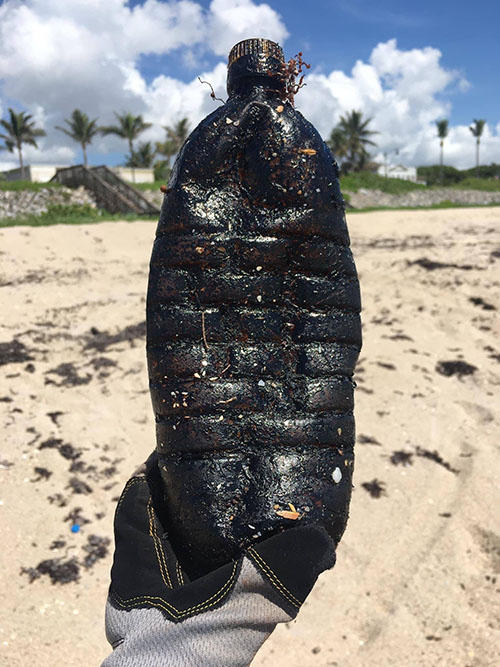
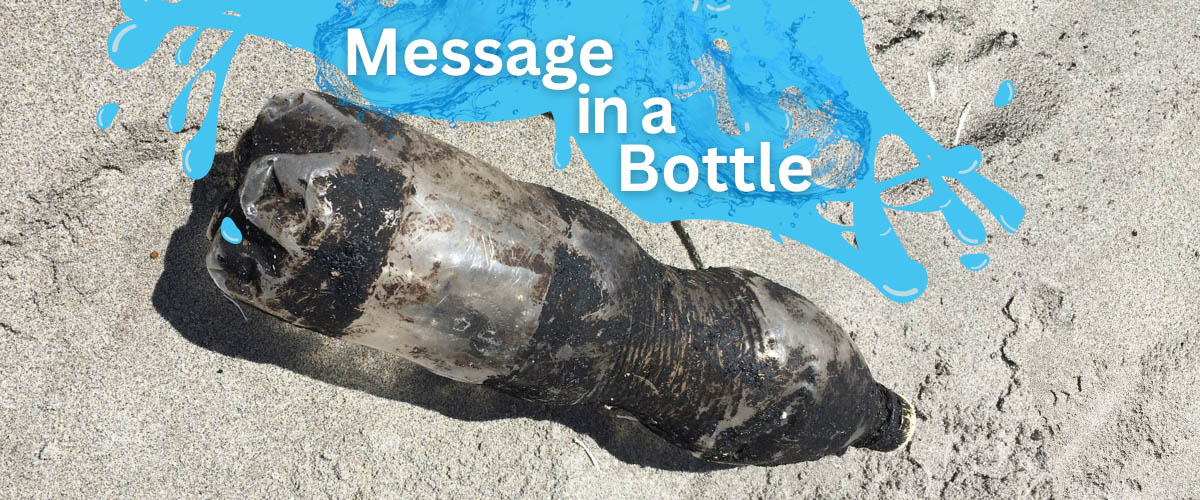
An oil-coated bottle found at Palm Beach in summer 2020.
Just the right combination of factors led to this hard to believe journey of thousands of miles. Just as the right combination of scientists came together to solve the mystery and sound an alarm about pollution in our oceans.
“The number of things that had to happen and the number of relationships that had to exist for this to all come together as fast as it did and have the capabilities to handle all of the analysis, it's really fortuitous.” said Rodgers.
“Many people believe there’s just one scientist in the lab who suddenly announces, ‘I solved it,’ like in CSI. But actually, solving mysteries usually involves a team of talented scientists — and we have that in this paper,” Reddy said.
The result was so unbelievable, Reddy says, that he hesitated to move forward with the paper. “I wasn't comfortable that we had the data to show that this actually happened”
When he put it aside and returned to it a few months later, the MagLab’s oil analysis eliminated his doubts.
“I doubt this paper would have been published without the outstanding collaborative work performed by the scientists at the MagLab,” Reddy stated.
MagLab analytical chemist Ryan Rodgers talks about the research into marine litter carrying oil across the ocean.
Other contributors to this research included scientists at Appalachian State University; Federal University of Ceara, Fortaleza, Brazil; Federal University of Pernambuco, Brazil; Haverford College; Memorial University, Canada; Texas A&M University; University of California, Santa Barbara; University of Houston; Western Washington University.