

Contact: Dave Graf
TALLAHASSEE, Fla. — Mother nature makes the best devices.
That’s the idea behind the latest research from MagLab user Kevin Nuckolls, an experimental physicist and postdoctoral fellow at the Massachusetts Institute of Technology.
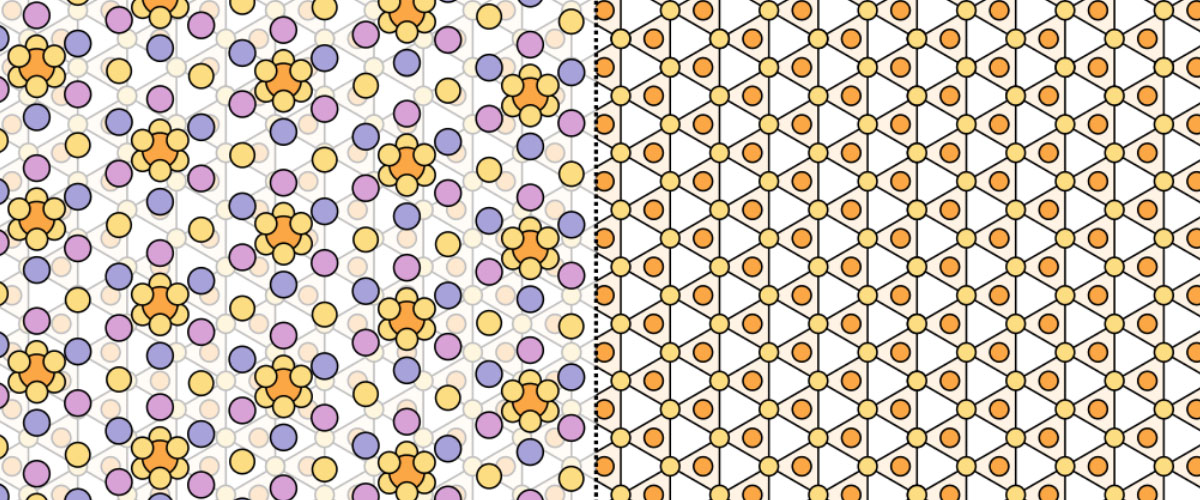
Nuckolls and a team of collaborators have discovered a new way to make a quantum material sandwich called a moiré material. Because of their tunability, moiré materials hold great promise as platforms for next-generation electronics. Moiré patterns are constructed by layering materials with lattices only a few atoms thick (so-called “two-dimensional materials”) atop one another like a sandwich, but with slightly misaligned lattices to create a much larger pattern called a “moiré superlattice.”
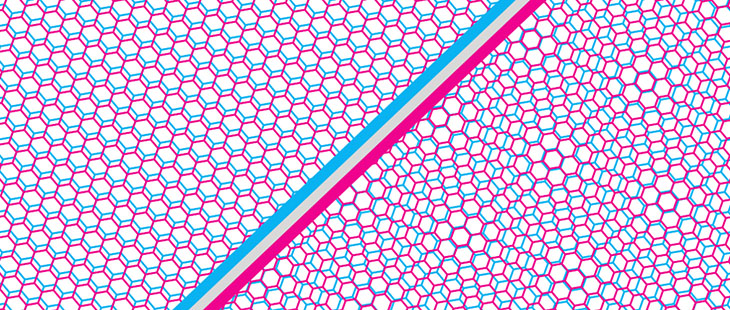
Schematic of a 2D material lattice (left) and a moiré superlattice (right) made by sandwiching two lattices, red and blue, with slightly different lattice spacings.
This superlattice can unlock dynamic properties such as superconductivity, where electrons flow without resistance. But there’s a big catch – until now, scientists had needed to construct these moiré material sandwiches by hand. They are assembled layer by layer, one by one, in a delicate, painstaking and time-consuming process.
“Two-dimensional materials host really beautiful physics and exciting material functionalities, but accessing and studying these properties has thus far required this laborious assembly process,” Nuckolls said.
That’s where Mother Nature comes in. Nuckolls and his teammates at MIT have developed a way to use solid-state chemistry to grow moiré materials in bulk, like a stack of 10,000 fully made sandwiches. Their paper, with collaborators at MIT, Harvard, Japan’s Toho University, and the MagLab, was published in Nature.
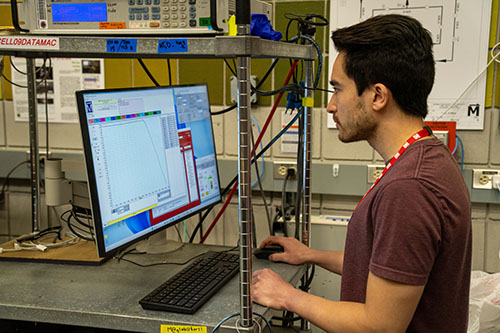
MIT physicist Kevin Nuckolls working at the MagLab.
“In some cases, we showed that you don't have to assemble these by hand anymore. You can actually use newly discovered chemical pathways to get there,” Nuckolls explained.
“This is groundbreaking,” said physicist Dave Graf, MagLab faculty researcher and co-author on the paper. “There's quite a construction process to making a moiré material sandwich. Kevin has discovered some of the same features, but in bulk. It’s a new direction for doing this kind of thing.”
“Mother Nature can grow these materials with nearly perfect moiré superlattices. They’re very high quality crystals that emulate the lattice properties and structures of 2D devices assembled by hand,” Nuckolls said.
Moiré materials are multifunctional. While a silicon transistor in a computer chip can simply be tuned ‘on’ or ‘off’ using electrical voltages, moiré materials have dozens of tunable functions, more like a dial than a simple switch. The chemical pathways that MIT researchers have discovered have the potential to open routes for incorporating these moiré materials in new kinds of electronic technologies.
“In many cases, moiré materials have 10 or 20 different electronic functions that are all native to one material, which can be tuned deterministically,” Nuckolls said.
The challenge is getting these moiré crystals to grow in a cohesive way that maintains the alternating misaligned layers that are key to creating the larger moiré pattern. Nuckolls navigated complex chemical regimes, using different catalysts and temperatures to find the right procedures.
“We learned from trying lots of recipes and analyzing what nature was capable of doing for us,” he said.
The family of moiré crystals all include three elements: strontium, tantalum, and sulfur. The sulfur atoms act as a sort of buffer between the strontium and tantalum.
“You can think of chemical bonding as atoms holding hands with each other. The sulfur atoms can hold hands with the strontium and tantalum atoms, but it’s very effective at pushing away these two elements that are very antagonistic against one another, who really don't like to bond with each other, who will almost never hold hands with one another,” Nuckolls explained.
This chemical push and pull helps build the layers of moiré crystals that unlock their new material properties. And when Nuckolls investigated the crystals in high magnetic fields, he realized just how unique the behavior was. So complex, electrons move through the material as if in a fourth dimension of space in a type of quantum tunneling.
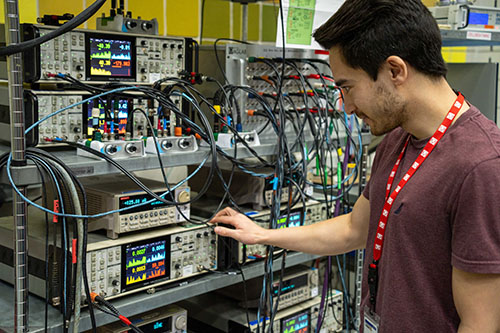
MIT physicist Kevin Nuckolls monitoring an experiment at the Maglab.
“This is a crazy property of this material, and it's one that we really didn't envision would ever be measurable in real experiments,” Nuckolls said.
The property is so crazy it’s hard even for physicists to explain. The material does not truly exist in higher dimensions, but the equations that mathematically model the exact motion of electrons in moiré crystals are written in four dimensions. Nuckolls says one way to visualize it would be to imagine the electrons in moiré crystals as cars driving around a mountain. They drive along a winding road until they disappear into a mountain tunnel, suddenly popping out on the other side. When the electrons enter this “quantum tunnel”, it’s as if they’ve entered a new four-dimensional world.
“The electrons act as if they have access to a 4th dimension that's independent of reality,” Nuckolls explained. “Electrons live in our three-dimensional world. But these crystals allow them to simulate perfectly the properties of what we would predict if we did experiments in four dimensions with a real four-dimensional metal.”
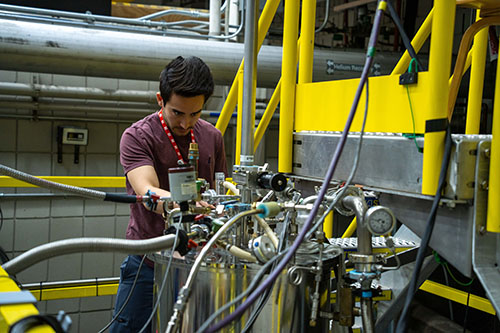
MIT physicist Kevin Nuckolls works at the top of a magnet.
High magnetic field measurements at the MagLab were crucial for uncovering this 4D behavior.
“We come to the lab and we learn so much to turn an idea into a real physics project and produce data that gives us a deep understanding of the quantum properties of materials,” Nuckolls said.
Graf sees a lot more opportunities for understanding moiré materials now that Nuckolls and his collaborators have discovered a recipe for making moiré crystals.
“Because these are bulk crystals, because they’re more robust than individual atom-thick layers, that opens up many more ways we can explore this material,” Graf said. “It’s amazing stuff. Kevin probably has the tip of the iceberg. Now that the inception of the idea is there, who knows what direction it runs from here.”
“It’s exciting to think about the potential opportunities,” said Joe Checkelsky, professor of physics at MIT and corresponding author of the new study. “There is a significant history of theoretical studies of higher-dimensional systems that might now be possible to examine experimentally in systems like these.”
One of the directions Nuckolls envisions is exploring ways to scale up these materials even more.
“We're working on ideas for transforming what we have into wafer-scale materials,” he said, meaning enough of the material and in the right form to build useful technology. “To take all of the electronic properties that the community has discovered in the recent decade and actually putting them into next generation electronics.”
“Higher-dimensional Fermiology in bulk moiré metals,” by Kevin P. Nuckolls, Nisarga Paul, Alan Chen, Filippo Gaggioli, Joshua P. Wakefield, Avi Auslender, Jules Gardener, Austin J. Akey, David Graf, Takehito Suzuki, David C. Bell, Liang Fu and Joseph G. Checkelsky, was published Feb. 18 in the journal Nature (DOI: 10.1038/s41586-026-10173-8). This work was supported, in part, by the Gordon and Betty Moore Foundation EPiQS Initiative (GBMF9070), the U.S. Department of Energy (DOE) Office of Science, Basic Energy Sciences (DE-SC0022028), the Office of Naval Research (ONR) (N000142412407), the Army Research Office (ARO) (W911NF-24-1-0234), the MIT Pappalardo Fellowship in Physics, the Air Force Office of Scientific Research (AFOSR) (FA9550-22-1-0432), the Swiss National Science Foundation (Postdoc.Mobility grant no. 222230). Part of this work was performed at the National High Magnetic Field Laboratory, which is supported by the National Science Foundation Cooperative Agreement No. DMR-2128556 and the State of Florida. The imaging work was supported the National Science Foundation (DMR-1231319, ECCS-2025158).