

Contact: Kristina Håkansson
TALLAHASSEE, Fla. — A dream team of researchers at Florida State University and the National MagLab is taking on a grand challenge-- trying to discover new antibiotics to treat the growing threat of drug-resistant bacteria.
Infection from so-called ‘super-bugs’ is now the third-leading cause of death globally, according to the World Health Organization. Drug resistant bacteria contribute to nearly five million deaths every year. As more pathogens develop resistance, that number is expected to jump nearly 70% in the next 25 years.
The FSU/MagLab team plans to screen soil microbes from around the world seeking natural sources for new antibacterial drugs. The Novo Nordisk Foundation is funding the project as part of an international drug discovery initiative. Molecules made by microbes have long been used to treat bacterial infections. The first antibiotic, penicillin, was developed from mold nearly 100 years ago. Common antibiotics like streptomycin are produced by bacteria.
“People have been searching for new antibiotics for many years, but it is becoming increasingly difficult to discover novel compounds. Our goal is to revolutionize the drug discovery pipeline,” said Xiangpeng Li, an FSU assistant chemistry professor who initiated the project.
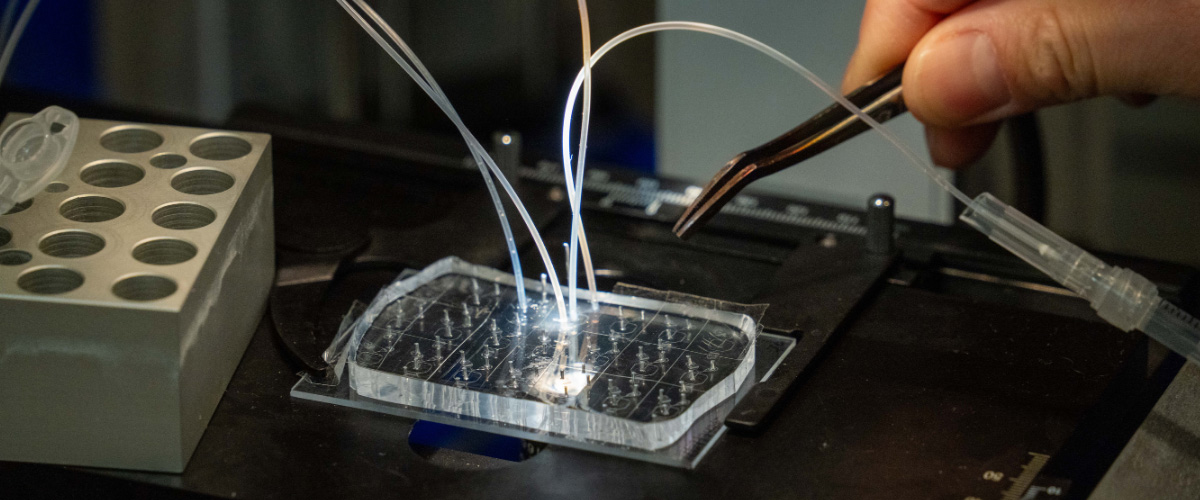
Li specializes in droplet microfluidics— manipulating tiny drops of fluid about the width of a human hair through troughs etched on a silicone disc to rapidly conduct chemical screening.
“I can design a droplet microfluidics system that enables ultra-high-throughput screening,” said Li.
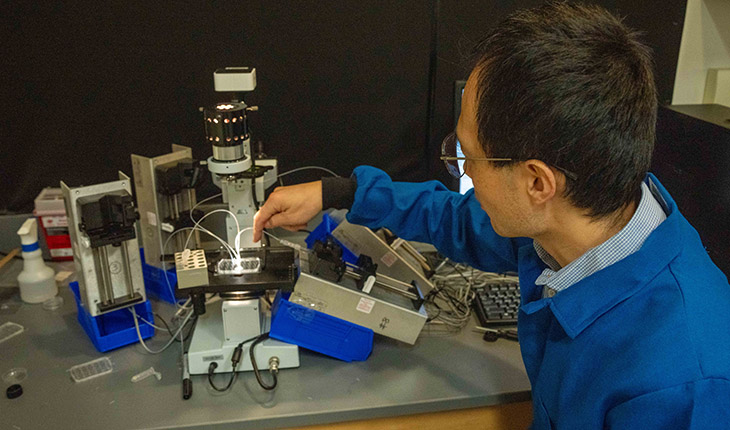
FSU chemistry professor Xiangpeng Li with his microfluidics system for droplet screening.
He’s among four FSU professors collaborating on the project, alongside members of the MagLab’s Ion Cyclotron Resonance team. Combined, they bring expertise in high-speed chemical screening, drug discovery, soils in extreme environments, chemical analysis of complex mixtures, and data management.
“I think it was really the very interdisciplinary team that helped us get this funding,” said Kicki Håkansson, director of the MagLab’s Ion Cyclotron Resonance Facility.
When Håkansson came to FSU and the MagLab in 2024, she started alongside Li and another new assistant chemistry professor, Edward Kalkreuter, who brings expertise in harnessing microbes for chemical innovations.
“I had just gotten to know all of these guys and we all said ‘Maybe we should just get together and do this.’ It’s just serendipitous,” Håkansson said.
The soil samples they test will come from yet another FSU colleague, Rob Spencer, a biogeochemist and professor in the Department of Earth, Ocean, and Atmospheric Science. He studies the carbon cycle, and particularly the rapidly changing environments of the Arctic and tropics.
“I had just started working with Rob who is a major user of the ICR facility,” Håkansson recalled, “I said, ‘Hey, Rob, you have soils, right?’ He has soil from Alaskan permafrost and tropical rainforests. He's been everywhere.”
“It’s common to think about soils as just dirt but they are essential for our nutrient, carbon, and water cycles, and microbes in soils hold huge potential for discovery of new drugs,” Spencer added.
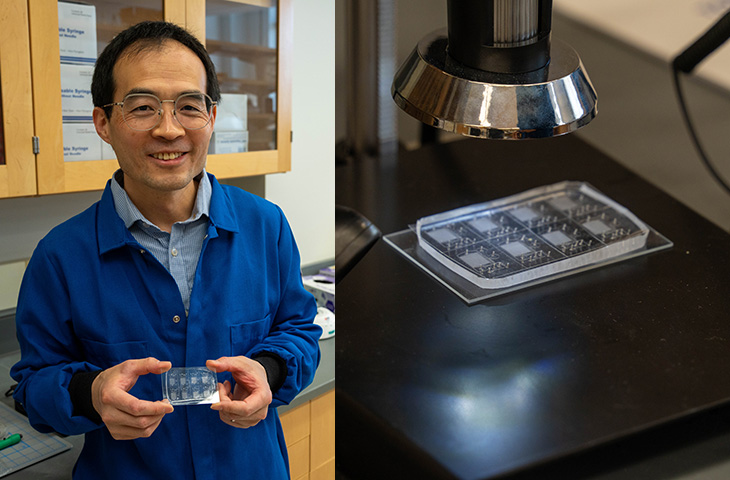
(Left) Professor Xiangpeng Li in his lab holding a microfluidics device. (Right) The piece of silicone is etched with tiny channels to control flow of microdroplets, allowing rapid screening and sorting of microbes in the search for new antibiotics.
Li says Spencer’s samples from extreme environments like the polar regions hold particular promise because they’ve not been studied extensively.
“Those samples might contain very novel microbes. They have been frozen for maybe tens to hundreds of thousands of years. We are more likely to find new things,” Li explained.
“Typically, when we search for new compounds from nature, it’s a rather arduous process working with individually isolated microbes, but with the speed of microfluidics and the analytical power of the ICR, we can sample all of the microbes from a variety of environments all at once. It’s a very exciting collaboration,” Kalkreuter said.
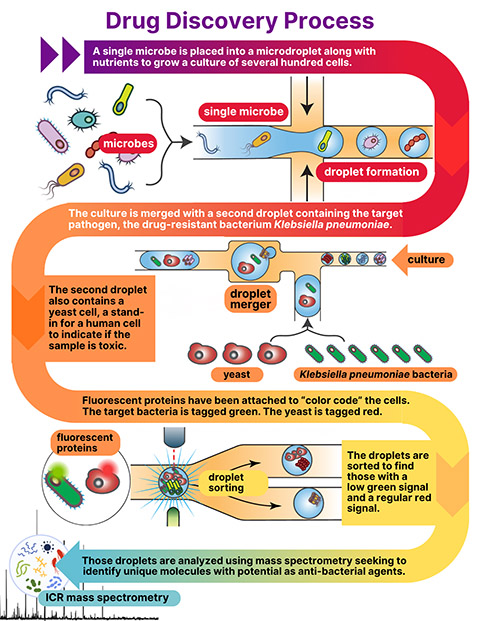
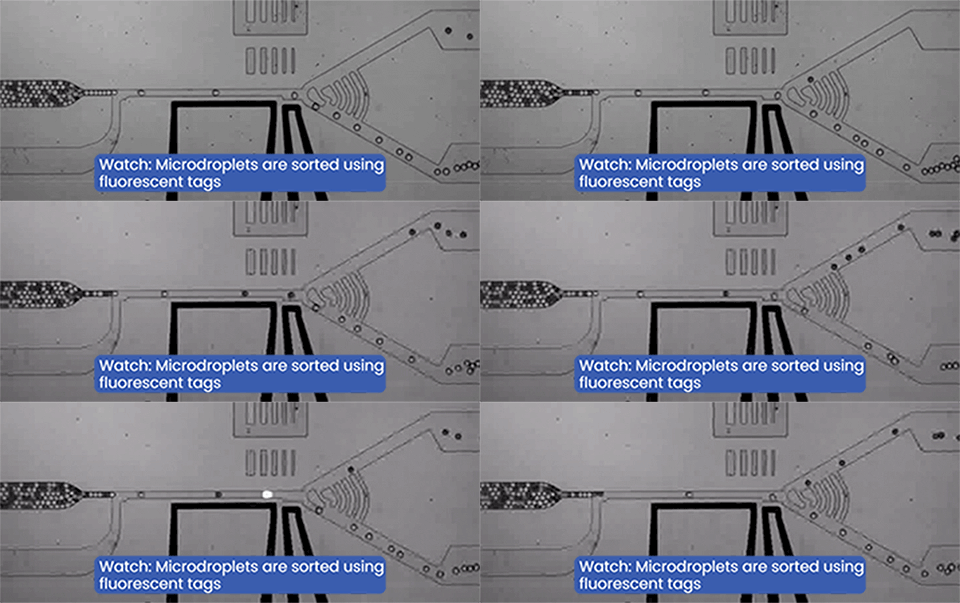
The team has the ambitious goal of screening a billion microbes. Li’s microfluidics system will quickly process tens of thousands of droplets at a time. Inside the droplets, soil microbial cells will be combined with a common antibiotic-resistant bacterium called Klebsiella pneumoniae. Fluorescent tags on the cells will color code what happens to allow rapid sorting. Then, identifying bioactive molecules from the soil microbes will be the job of the MagLab’s ICR facility.
“You might have a soil sample and it kills the Klebsiella, but you don't know what those molecules are. So that's where we come in,” Håkansson said.
The lab’s powerful ICR mass spectrometers will analyze the droplets that show antimicrobial activity to determine which molecules are giving it the antibacterial properties. The precision analysis will also be crucial for making sure the discovery is indeed new.
“We're looking for signals that have not been discovered before. We don’t want to rediscover penicillin,” Li said. “To do that, we annotate the molecular composition of each signal and compare it against databases of known compounds.”
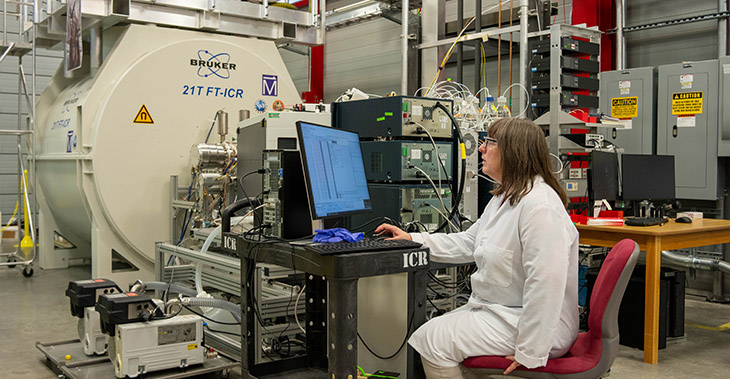
Kicki Håkansson at the MagLab’s 21-tesla ICR mass spectrometer, one of the systems that will be used in the drug discovery initiative.
Taking on that data analysis challenge will be the team’s fifth key member— Håkansson’s MagLab colleague Ryan Rodgers.
“We're going to generate so much data. How are we going to mine all these data?,” Håkansson said. “That's when I said, ‘Well, I know a guy,’ and I invited Ryan because he's developed all these automated calibrations and peak annotations for the ICR facility.”
The researchers will also share data and ideas with 21 other research groups around the world as part of an international drug discovery consortium with additional funding provided by the Gates Foundation and the Wellcome Foundation. This coordinated investment and collaborative effort will accelerate the search for new medications that are crucial to addressing this growing crisis.
“Everybody knows, if we don't do anything, antibiotic resistance will be a huge problem for the human race,” said Li.
“This new approach allows us to look very thoroughly at compounds that haven't been looked at,” said Håkansson, “And if we find something, this could be transformative, which is what's really exciting.”