

Contact: Frederic Mentink-Vigier
TALLAHASSEE, Fla. — The technology behind MRI, which has been used for generations to diagnose and treat disease, holds promise of even greater breakthroughs across scientific disciplines using stronger magnets and advanced techniques.
That’s why the FSU-headquartered National High Magnetic Field Laboratory is launching a new one-of-a-kind magnet facility to build on its world leadership in Nuclear Magnetic Resonance. The U.S. National Science Foundation has awarded $18 million to create the MagLab’s new National Facility for Ultra-High Sensitivity Solid-State NMR.
“This facility will provide previously inaccessible capabilities for understanding the structure and dynamics of matter at the atomic scale - critical to U.S. priorities in biotechnology, energy, advanced manufacturing, and health,” the NSF said in announcing the award.
New Magnet, Expanded Capabilities
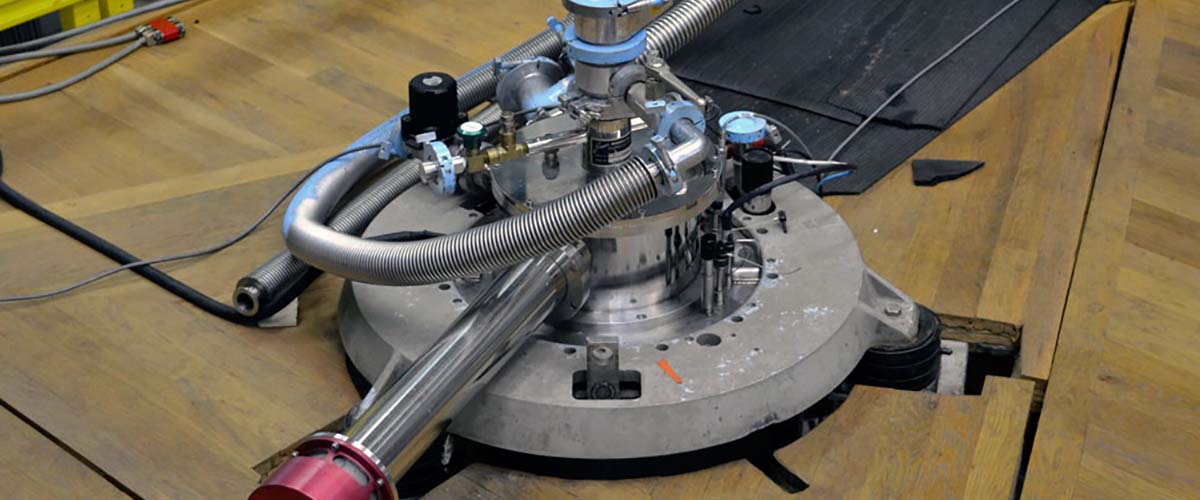
The new ultra-high-sensitivity facility will center around a new 23.5 tesla NMR magnet, one of the strongest in the United States, complemented by a microwave source and state-of-the-art probes which together will accelerate data acquisition for a wide range of research.
“This grant will fund a unique instrument worldwide. It's a significant milestone and exciting news for the MagLab, FSU and the US as a whole,” said Frederic Mentink-Vigier, lead researcher for the project, MagLab Research Faculty and Affiliated Faculty in the FSU Department of Chemistry and Biochemistry.
“What this instrument is opening up is the ability to look at samples with higher sensitivity, and thus to look at the entirety of the periodic table.”

All this is essential to be able to understand disease and have cures.
- Frederic Mentink-Vigier
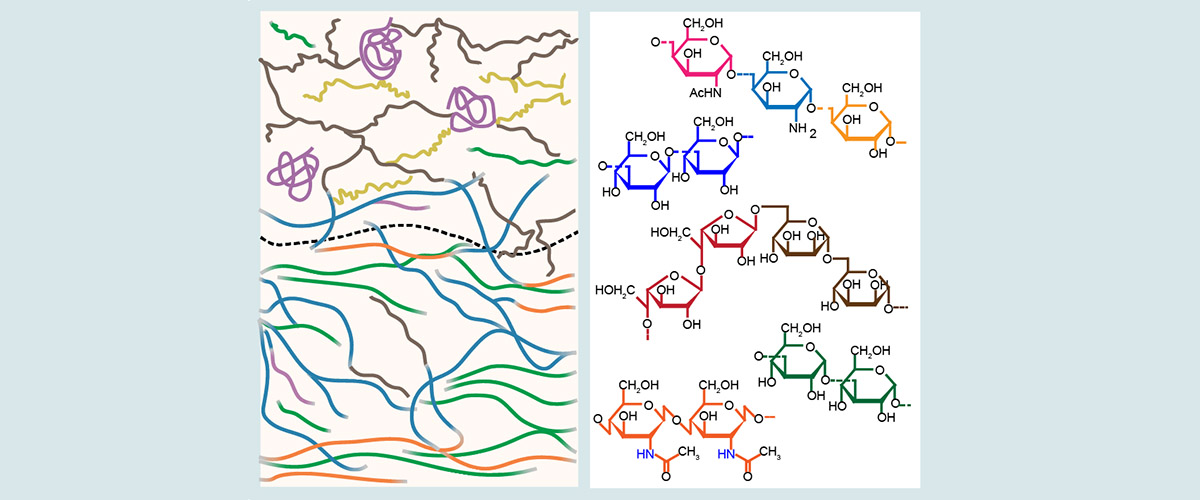
Nuclear Magnetic Resonance harnesses high magnetic fields and radio waves to figure out the 3D structures of biomolecules, uncover the mechanisms of enzymes and catalysts, and provide insights into surfaces and interfaces at scales far beyond the reach of conventional microscopes.
In biomedicine, that means detecting and understanding biologically essential elements such as iron, copper, sulfur, and calcium, along with greater study of amyloid proteins — which play a role in Alzheimer's, Parkinson's, Type II diabetes, and other diseases. The system will also allow detailed analysis of membrane proteins that act as cell gatekeepers. These mechanisms are involved in diseases including cancer, autoimmune disorders, and infectious disease.
"All this is essential to be able to understand disease and have cures," said Mentink-Vigier.
The instrument will also expand capabilities to see elements such as lithium and sodium being studied for new solid-state batteries. And scientists will be able to better detect cadmium, selenium, and lead-- important in electronics, solar cells, and LEDs-- along with platinum-group metals, which play critical roles in catalysis and medicine.
The MagLab’s NMR team has been working to secure funding for the new magnet for years, led by former NMR Facility Director Robert Schurko, who passed away in February 2026 after a battle with cancer.
“This was our fourth, and boldest, attempt to secure such instrumentation. This was a project that was very important for the MagLab and Rob was committed to see it succeed.” said Mentink-Vigier.
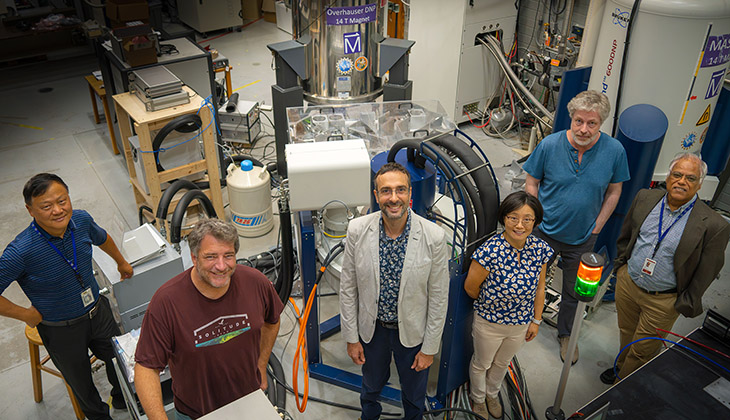
Members of the National MagLab’s NMR team (left to right): Zhehong Gan, Thierry Dubroca, Fred Mentink-Vigier, Yan-Yan Hu, Peter Gor’kov, & Ayyalusamy Ramamoorthy.
Photo credit: Stephen Bilenky/National MagLab
World-Leading Techniques
Mentink-Vigier's research focuses on Dynamic Nuclear Polarization, a technique in which he is a world-renowned expert. This new instrument represents the cutting edge of DNP, a signal amplifier that improves sensitivity by up to four orders of magnitude. The system will also utilize Magic Angle Spinning, combined either with DNP or cryoprobes, to improve resolution. That technique can lower measurement times by a factor of up to 16. This will be the only ultra-high-field magnet in the world equipped with both Magic Angle Spinning and Dynamic Nuclear Polarization.
“When people want information out of the NMR experiments, this is the combination: Magic Angle Spinning gives you resolution and Dynamic Nuclear Polarization gives you signaling intensity,” said Mentink-Vigier. “We have the ability to do experiments that previously we were not able to do. What you could not absolutely see before, you can now see.”
Yan-Yan Hu, MagLab researcher and Professor of Chemistry and Biochemistry at FSU, says the magnet system will be transformative. Hu's research focuses on understanding how proteins interact to carry out essential biological functions and on developing safer, more efficient rechargeable lithium and sodium batteries.
“This new facility will allow researchers to tackle materials and biological systems that have previously been extremely difficult or impossible to study by NMR,” said Hu.
Serving the Scientific Community
Installation of the new magnet system is planned for the start of 2028, with access for users from around the world starting the following year. The new magnet will operate as part of the MagLab’s large user program, serving more than 1,600 academic researchers and companies each year, and providing a technical training ground for students who will help build the future STEM workforce.
“Our NMR program is already known for its unparallelled equipment and expertise. This will only expand what's possible for top scientists from around the world who come here to push the boundaries in biology and other disciplines,” said MagLab Director Kathleen Amm.
This will only expand what's possible for top scientists from around the world.
- Kathleen Amm
“I am delighted to see this remarkable facility become a reality and serve the scientific community,” said Ayyalusamy Ramamoorthy, MagLab researcher and Professor of Chemical and Biomedical Engineering at FSU.
Ramamoorthy’s lab investigates amyloid formation, dynamic structures of membrane proteins, as well as the roles of biological relevant metals in disease-related molecular processes.
“This award further amplifies the MagLab’s impact by empowering scientists from around the world to make new discoveries,” said Ramamoorthy.
The project draws on an exceptional team of magnetic resonance experts. Other key contributors include Zhehong Gan, Thierry Dubroca, and Peter Gor’kov at the MagLab’s FSU headquarters, along with Joanna Long at the lab’s University of Florida site. These leaders will be instrumental in establishing the platform and ensuring its long-term success.
A Legacy of NMR Leadership
The facility will also serve as a legacy of Schurko, who spent his career extending the use of solid-state NMR research and discovery.
“Rob was the catalyst that brought us together around a shared vision — to create a unique facility that would push the boundaries of solid-state NMR. We are honored to carry his vision forward. This award is a testament to Rob's legacy and our collective commitment to making this facility a reality," said Mentink-Vigier.
The National MagLab is funded by the U.S. National Science Foundation and the State of Florida.