Contact: Ayyalusamy "Rams" Ramamoorthy
TALLAHASSEE, Fla. — Leading researchers from around the world gathered at the MagLab April 30 and May 1 to discuss the latest discoveries in a rapidly growing area of study—lipid nanodiscs. The super-small discs have emerged as a powerful and versatile platform for biomedical research.
“These discs have many promising applications. They still are being developed and exponentially growing,” said Ayyalusamy Ramamoorthy, MagLab researcher and biomedical engineering professor in the FAMU-FSU College of Engineering. He organized the lab’s first-ever symposium on lipid nanodiscs.
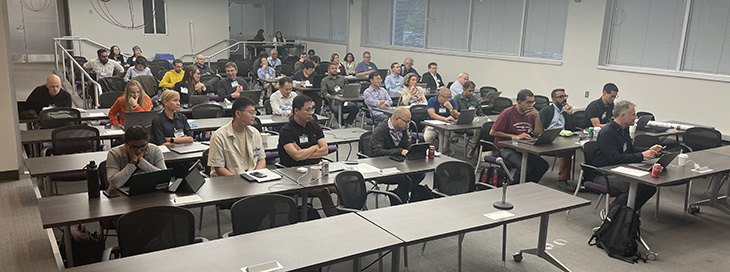
Scientists listen to a presentation at the MagLab’s Symposium on Lipid Nanodiscs.
Experts in biomedical engineering, biophysics, structural biology, chemistry, and pharmaceutical science from across the US, Europe, Africa and Asia presented their research during the two-day conference. Talks featured the latest advances in designing, building, and utilizing nanodiscs.
“It's a chance to see how we're pushing this technology forward,” said Loren Andreas, a biochemist at the Max Planck Institute for Multidisciplinary Sciences in Göttingen, Germany, who is studying a protein in the coronavirus. “I'm hoping to interface with a lot of different people and see what's new and what we might be able to apply to our research.”
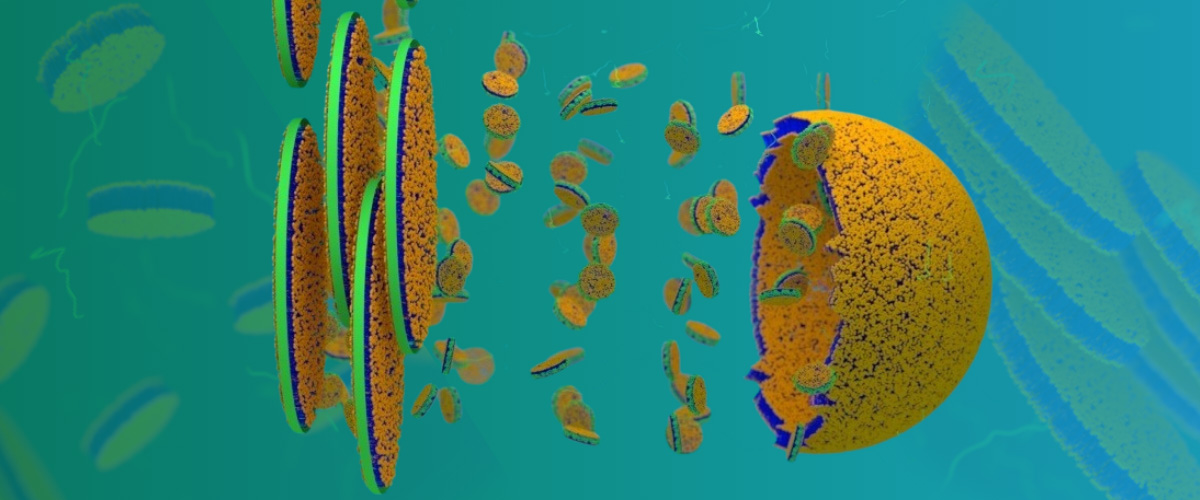
Nanodiscs, bioengineered from a combination of fatty molecules called lipids and “detergent-like” molecules (proteins or peptides or synthetic polymers or small molecules), are about 10,000 times smaller than a human hair. The tiny platforms can be used to hold a fragile cell membrane protein.
Membrane proteins are critical for biological processes, serving as channels to control what enters and leaves a cell and as sensors to transmit chemical signals. But scientists have struggled to study their functions because the membrane proteins are so fragile. That’s where the nanodisc comes in as a platform. The lipids that make up the disc mimic a cell membrane, providing a stable environment for the proteins.
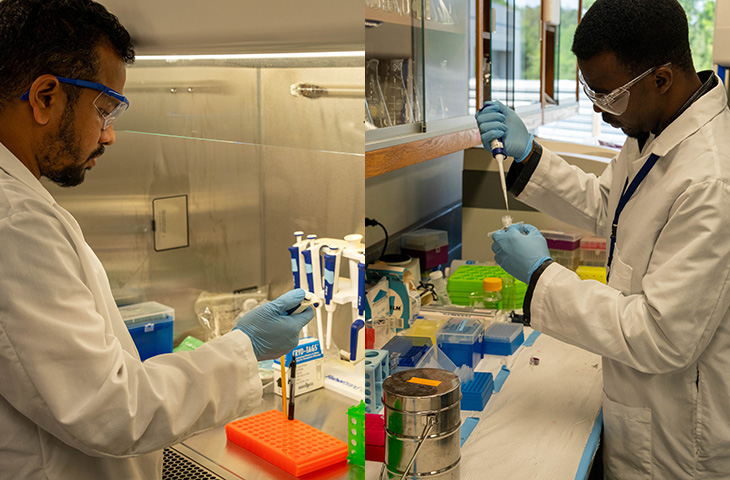
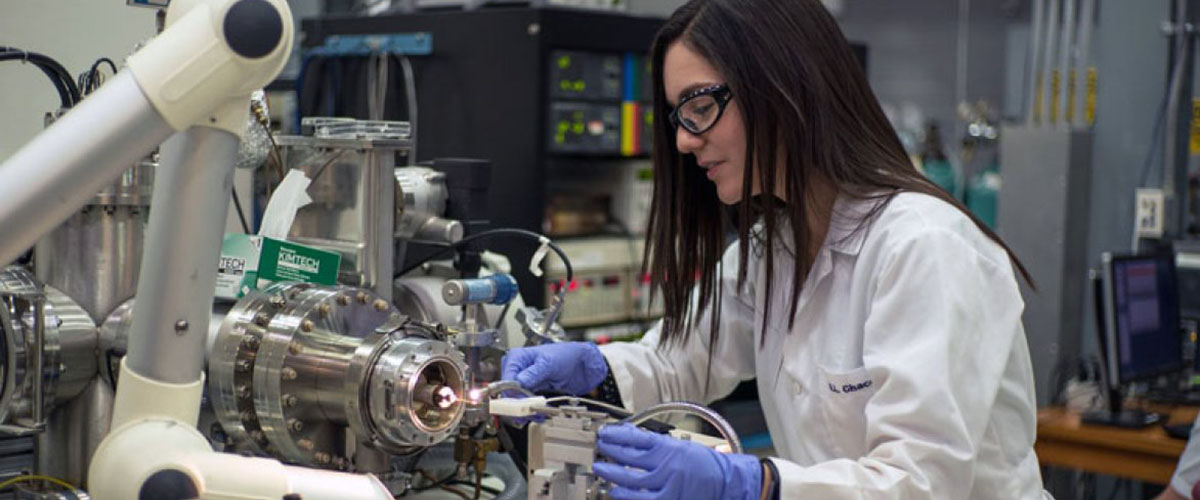
Postdoctoral fellow Rokon Khan and graduate research assistant Cletus Obi work on lipid nanodiscs in Ayyalusamy Ramamoorthy’s lab.
You can think of the disc structure like a piece of sushi. The membrane protein sits at the center, like the sushi meat. It’s surrounded by the lipids, like the rice surrounds the meat. And the piece is all held together by a scaffold (made up of proteins or peptides or synthetic polymers or small molecules), like the belt of seaweed around the sushi.
Conference organizer Ramamoorthy has been working on lipid nanodiscs for years with various applications. Using high-field nuclear magnetic resonance at the MagLab, his areas of research include the discs’ potential for delivering drugs to treat human diseases including Alzheimer’s disease, Parkinson’s disease and cancer.
“A targeted drug delivery, either to the brain or to the heart or to cancer cells, and so on,” Ramamoorthy said.
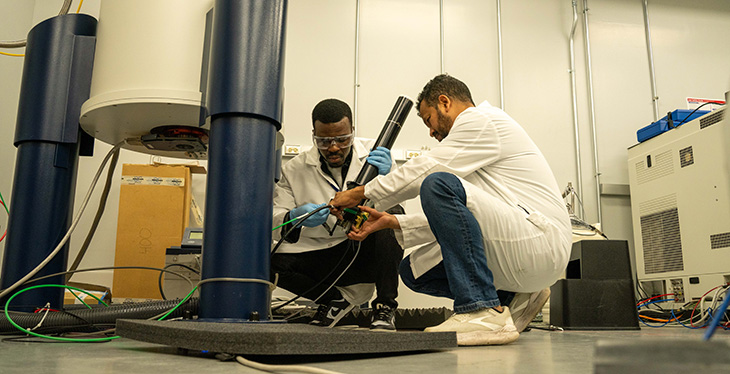
Graduate research assistant Cletus Obi and postdoctoral fellow Rokon Khan get ready to load a probe into a nuclear magnetic resonance magnet for nanodisc research at the MagLab.
Debasis Das, a biochemist attending the symposium from the Indian Institute of Science in Bengaluru, is utilizing nanodiscs to study the structure and function of enzymes that could be used to create biofuels.
“We are planning to use different types of nanodisc technology to get better output from our enzymatic systems,“ Das said. “This can give us very good resolution structures which will tell us more about the function and the mechanism of these hydrocarbon-producing enzymes. The enzymes that we are working on can convert fatty acids, which are naturally highly abundant and inexpensive, to hydrocarbons which are highly valuable molecules.”
The number of researchers using lipid nanodiscs has been growing, but this is one of the first conferences where so many experts in this field of study have come together in person.
“I'm excited to be here because it's all the people of the community. We know each other either by references, or publications,” said Manuela Zoonens, a biochemist at CNRS in Paris, the French National Centre for Scientific Research. “We never meet in person. So, this is a big opportunity to meet the researchers of this community who don’t usually get together like this.”
“We have to continue to develop tools like this,” Zoonens said. “But there are also limitations. We need to be aware about what type of difficulties are in front of people so we can try to improve this for new applications and innovations.”