

Contact: Edan Schultz
TALLAHASSEE, Fla. — You or someone you know has likely had an MRI. Magnetic resonance imaging has dramatically enhanced diagnosis and treatment of diseases for nearly 50 years, improving healthcare for tens of millions of people worldwide.
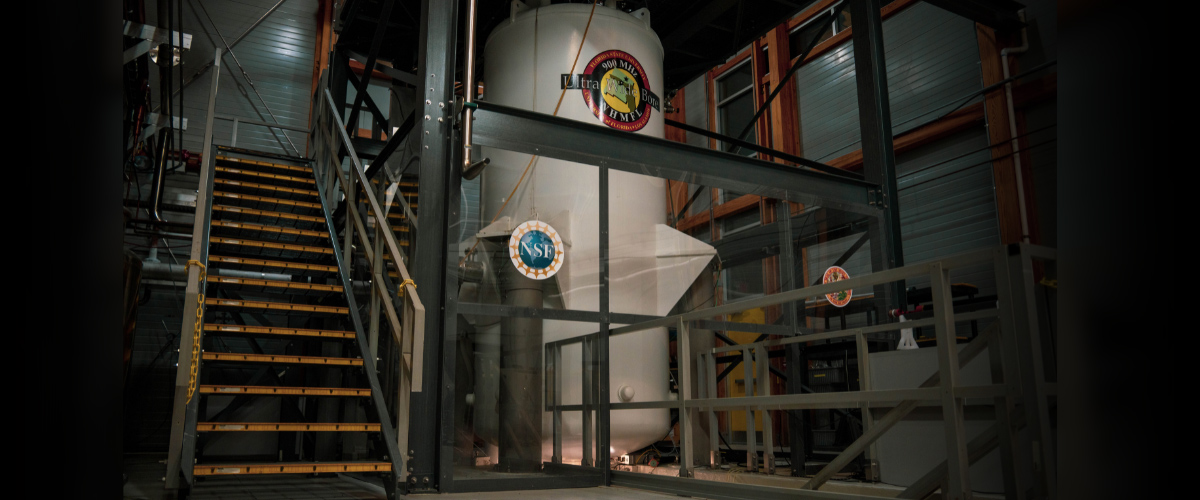
The world’s strongest MRI – home-built and launched for user operations at the National MagLab in August 2005 - has taken the groundbreaking medical imaging to another level. Now, the MagLab is celebrating 21 years of operating its flagship 21-tesla MRI magnet, along with the thousands of scientists from around the world who have harnessed its power and precision for experiments in biology, chemistry, and beyond.
A Marvel Magnet That’s Always On
Designed and built by the lab’s Magnet Science & Technology department at a cost of $16 million, the magnet is a marvel of engineering. It contains 96 miles of niobium-tin and niobium-titanium superconducting wire, carrying electricity without loss of energy. Current flows perfectly as long as the wire is kept cold with liquid helium at a temperature of -456° Fahrenheit. Since it was first energized decades ago, the magnet has run almost non-stop, generating groundbreaking research.
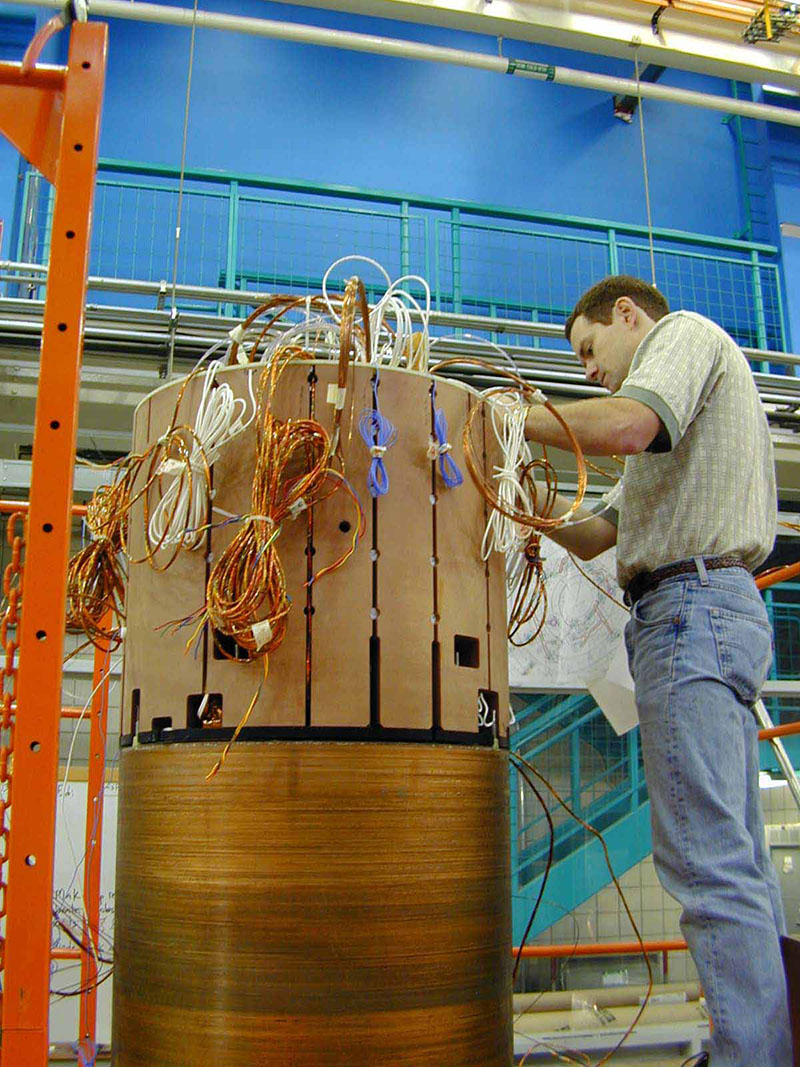
The 21-tesla MRI machine during assembly.
In MRI, scientists use magnetic fields and radio waves to find the precise location and orientation of certain atoms in the material they’re studying. The 21T MRI is 14 times more powerful than a typical hospital MRI. Its four-inch bore, the experimental space at the center of the magnet, allows high resolution views at a microscopic level of small animals such as rats, hamsters, mice, birds, and insects. Whereas a typical MRI detects hydrogen, the 21T’s extremely high field can also see less abundant elements that play key roles in the body, including sodium, lithium, oxygen, phosphorus, and carbon. That offers an invaluable glimpse into biological processes playing out in living creatures in real time. And because the imaging is harmless, researchers can monitor changes in muscle, brain tissue, tumor cells, and more over an animal’s lifespan, providing vast data and insight on the leading health challenges of our time.
“This magnet was so ahead of its time when it first went online, and it continues to lead the world for MRI science,” said MagLab Director Kathleen Amm. “It has enabled incredible research for decades and I know there are many more discoveries to come.”
Cutting-Edge Medical Research
Ayyalusamy Ramamoorthy, a MagLab researcher and professor with the FAMU-FSU College of Engineering, has been using the magnet’s exceptional capabilities to study Alzheimer’s disease.
"The unique benefits of the instrument enable us to evaluate Alzheimer's disease-related amyloid toxicity and neuroinflammation using magnetic resonance imaging and magnetic resonance spectroscopy experiments on animal model systems," said Ramamoorthy.
Another research group delivered tiny stem cell vesicles to mice with symptoms of Alzheimer’s. Over four months of scanning in the powerful MRI, those mice saw reduced buildup of harmful plaques in their brains and performed significantly better on learning and memory tests, showing the microscopic stem cell particles could become a powerful, non-invasive treatment to slow Alzheimer's.
Researcher Shannon Helsper says the 21T became a cornerstone of her PhD work, as she investigated the impact of stem cell-derived therapies in stroke.
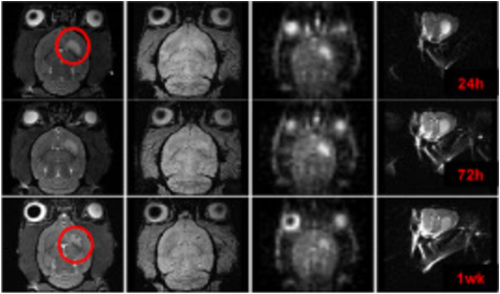
Scans of rat brains showing stem cell impact on stroke lesions.
“The capabilities of the 21.1 T system enabled me to study disease processes and treatment responses at an unprecedented level of detail, providing insights into underlying biological mechanisms,” said Helsper, who is now a Senior Postdoctoral Fellow at KU Leuven in Belgium. “Beyond my own research, I had the opportunity to work alongside many incredible scientists from around the world.”
Scientists examining brain tumors in rats using the 21T discovered that the tumor cells leak sodium, causing a spike in sodium levels days before a tumor shrinks. This helped distinguish between drug-sensitive and drug-resistant tumors before treatment began and uncovered how resistant tumors shift their metabolism to survive. By pinpointing these exact genetic and chemical shifts, the hope is doctors can eventually predict drug resistance early and customize treatments to destroy the cancer from day one.
Other biochemists tracking sodium with the 21T magnet found a link between migraines and sodium distribution in the brain. The team scanned rats and saw a spike in sodium levels within the brainstem before any migraine symptoms appeared. This new finding helps pinpoint exactly where migraine symptoms may start, paving the way for more effective future therapies for millions of migraine sufferers.
“It is a truly unique instrument — 21 years after it was first commissioned, it remains the world's strongest MRI/NMR magnet with a 10-centimeter bore. As a doctoral student, postdoc and later research faculty — together with the user community — we were able to produce groundbreaking MRI research at ultra-high fields,” said Jens Rosenberg, now a manager at the MagLab’s MRI facility at the University of Florida. “
Materials Breakthroughs
It’s not just medicine. The strongest MRI in the world’s high-resolution images are useful in other fields of study, including materials science.
Researchers are using the magnet to study next-generation "solid-state" lithium-ion batteries. The batteries could offer safer, more stable and reliable power for things like phones, laptops, and electric vehicles.
“The high-field magnetic resonance imaging capabilities have been instrumental in helping us track the evolution of functional materials used in solid-state rechargeable batteries,” said researcher and FSU professor Yan-Yan Hu. “The spatial and temporal resolutions offered by the 21-T instrument are unparalleled and critical for understanding transient processes in real time and under device operating conditions.”
Hu’s team analyzed the formation of lithium buildup that stands as a barrier to solid-state battery performance. Mapping how tiny needles of lithium form and connect, the team created a blueprint for new material and battery engineering. Working with Samsung, the group is also exploring use of lithium gels rather than solids for battery construction, where a phenomenon known as charge-clustering can lead to faster charging and longer battery life.
From watching the internal workings of batteries in real time to tracing the subtle cellular shifts of a migraine, the one-of-a-kind 21T MRI magnet has proven over two decades its game-changing capabilities. And just like the electricity flowing through its perfectly conducting wires, this powerful instrument shows no signs of stopping.
The National MagLab is funded by the U.S. National Science Foundation and the State of Florida. The lab is headquartered at Florida State University with satellite campuses at the University of Florida and Los Alamos National Laboratory.