What is the finding
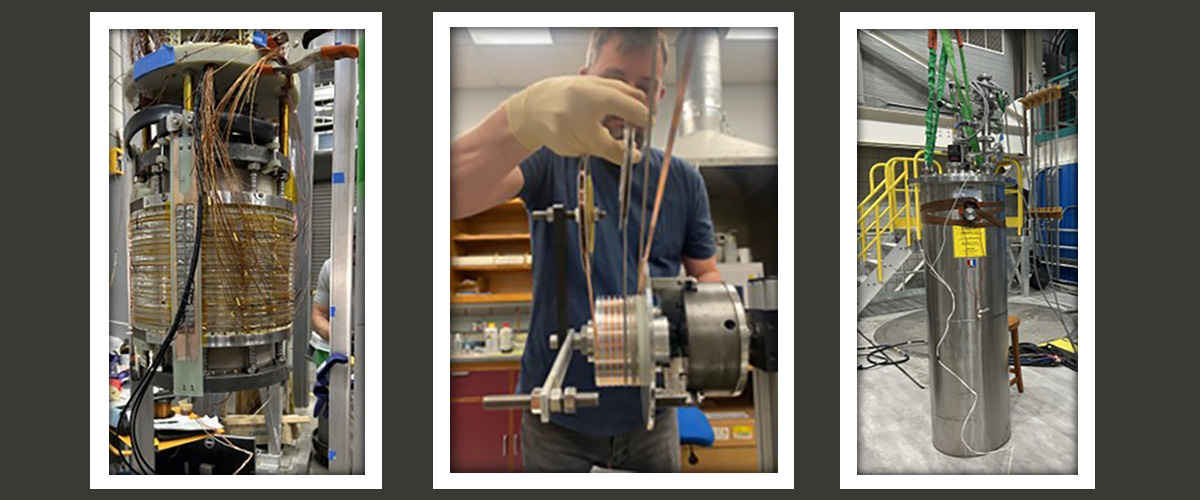
MagLab researchers successfully tested a REBCO high-temperature superconducting coil designed to mimic a future 40 T all-superconducting magnet. The coil reached its full design current of 645 A, generating 5 T on its own for a total field of 16.4 T; achieved 70% of its short-sample critical current—a first for a coil of this type; withstood seven forced quenches and maintained structural integrity; and demonstrated new field-control techniques to stabilize the magnetic environment.
Why is this important?
This test demonstrates that REBCO coils can meet the extreme performance, stability, and protection requirements needed for next-generation high-field magnets like the world’s first 40 T all-superconducting magnet, which will offer unprecedented research capabilities. This work also improves future predictive models for coil behavior and provides key data for design changes before final magnet construction.
Who did the research?
Iain Dixon1, Shannon Griffin1, Kwangmin Kim1, John Rogers1, Dharmendra Shukla1, Yu Suetomi1, Hongyu Bai1, Erick Arroyo1, Brent Jarvis1, Justin Deterding1
1National MagLab, Florida State University
Why did they need the MagLab?
Only the MagLab provides the field strength, stability, and experimental environment needed to validate technology for a 40-tesla superconducting magnet. The MagLab’s unique facilities acted as a “magnet test bed” providing extreme environments that used the outer super-conducting coils of the 45 T Hybrid magnet to provide a magnetic environment of 11.4 T in a -452 °F (4.2 K) cold bore of 353 mm diameter.
Details for scientists
- View or download the expert-level Science Highlight, Demonstration of Technology Suitable for an All-Superconducting 40 T Magnet through Testing of a Large-Scale REBCO Coil
- Read the full-length publication, The 40 T Superconducting Magnet Project at the National High Magnetic Field Laboratory, in IEEE Transactions on Applied Superconductivity
Funding
This research was funded by the following grants: K. M. Amm (NSF DMR-2128556, NSF DMR-2131790)
For more information, contact Tom Painter.