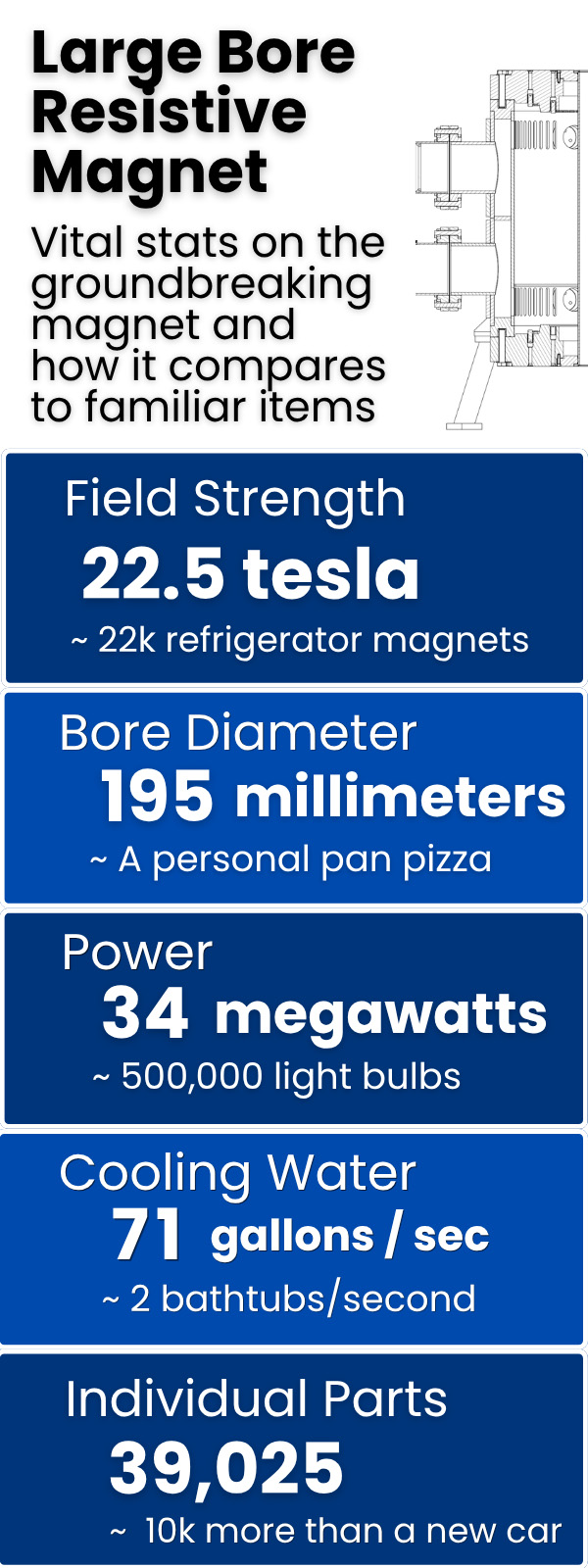


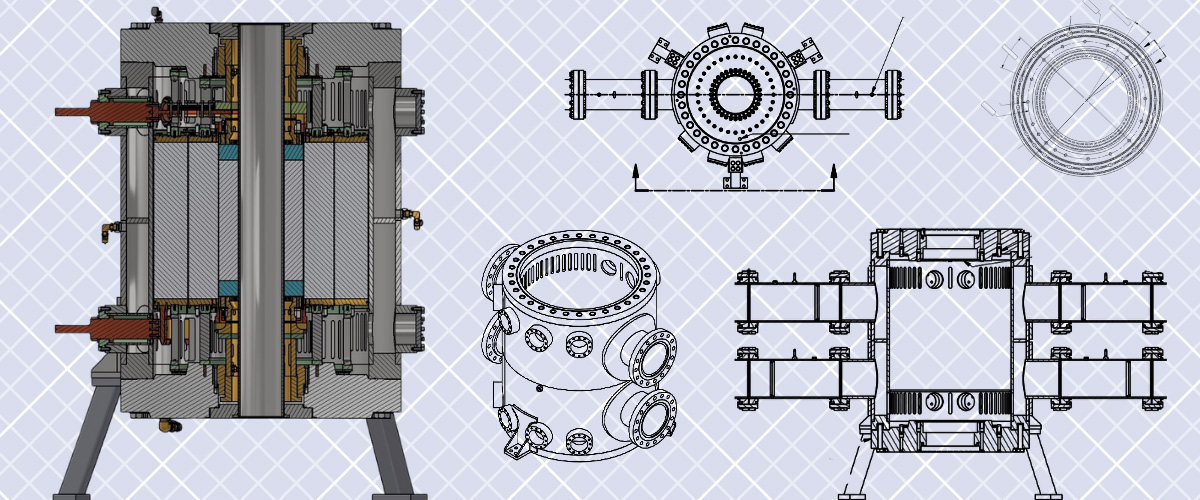
MagLab engineers are designing and building a next-generation large-bore resistive magnet. The magnet will produce a 22.5 tesla continuous magnetic field with a bore of 195 millimeters, or 7.6 inches. Most of the lab’s other magnets have bores of less than two inches. The larger space at the center of the new magnet will provide room for bigger samples, complex instrumentation, and advanced research.
The combination of very high magnetic field strength with a very large bore is groundbreaking. Achieving both of those parameters simultaneously requires innovations in coil design, materials, cooling systems, and power delivery.
The project leverages the MagLab’s world-leading expertise in:
- High-field resistive magnet design and engineering
- Advanced conductor and coil fabrication
- High-current electricity supplies, heat management and high-power cooling systems
- Mechanical stress management under extreme forces
The large bore and high field will open opportunities for entirely new kinds of experiments:
- Advanced characterization of superconductors, including high-temperature superconducting coils, to test the limits of the materials in high-magnetic-fields.
- Research requiring bulky sample environments which could include equipment such as cryostats, pressure cells, and furnaces.
- Coupled measurements of materials in high temperatures and high magnetic fields as required in fusion reactors.
Research using this new magnet will drive breakthroughs such as:
- Development of next-generation energy technologies including superconductors and fusion reactors.
- Advances in electronics and quantum technologies for artificial intelligence.
- Innovations in medical and imaging technologies.
The project will also advance U.S. leadership in high-field science and technology and train the next generation of scientists and engineers in cutting-edge research environments.
The $6 million large bore resistive magnet is being funded by the U.S. National Science Foundation core grant and the Florida State University Office of Research. The magnet is set for completion in summer of 2028.