Insects are one of the most diverse groups of animals on Earth, with over a million known species, and they play important roles in various ecosystems as pollinators, decomposers, and as sources of food for other animals. Some examples of insects include ants, bees, butterflies, beetles, and flies.
Keep reading to learn more about insects, or click on the button to play Insect Investigation!
Play Insect Investigation
What is an insect?
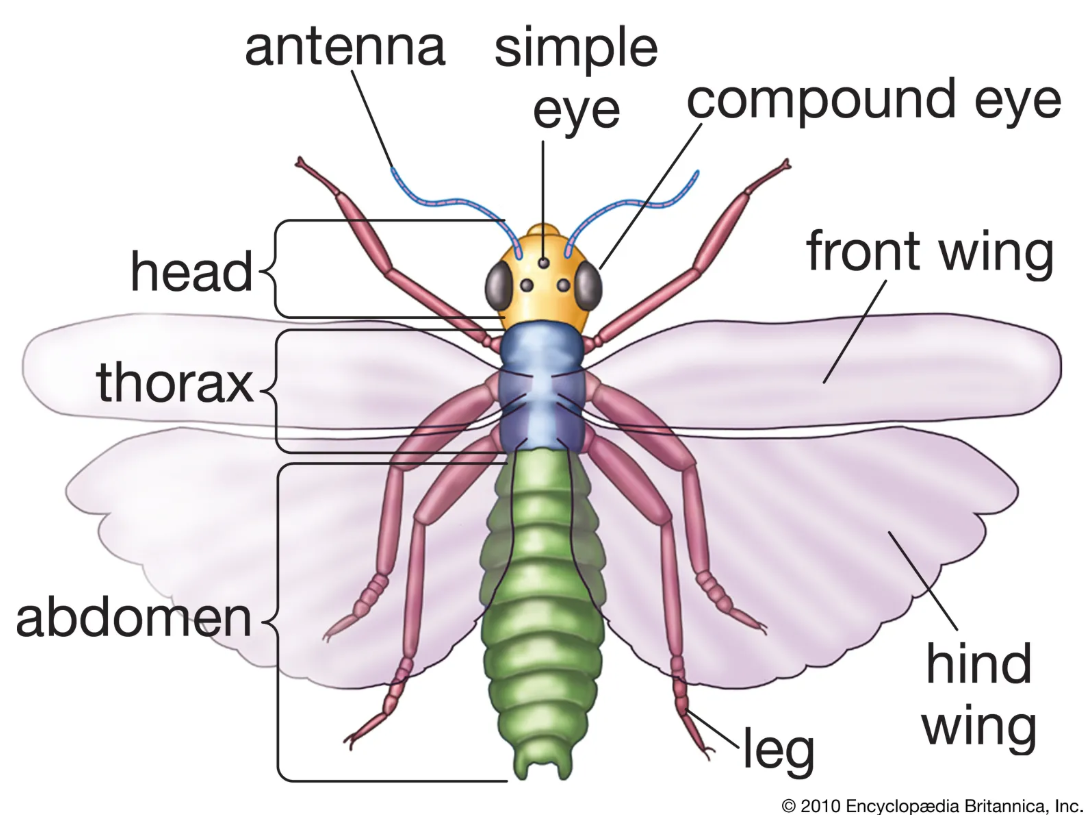
An insect is a type of arthropod that belongs to the class Insecta (Latin for “notched,” referring to their segmented bodies). Insects have three body parts: the head, the thorax, and the abdomen. Insects also have three pairs of jointed legs (six legs), typically two pairs of wings, and a pair of antennae.
All insects are arthropods (Greek for “jointed foot”), animals with exoskeletons, which is a hard outer covering, and jointed legs. They are an extremely successful group of animals throughout the history of Earth, which means they've been around for over 400 million years.
For an arthropod to be an insect, there are certain features it must have:
- All insects have three main body parts: a head, a thorax, and an abdomen.
- All insects have six legs. An animal like a spider, which has eight legs, is not an insect.
- Most insects have two pairs of wings, but some can have zero or one pair.
- Most insects have a pair of antennae on their head. The insect moves around the antennae to sense chemical signals in the air.
Parts of an insect
Head
The head is the front part of the insect’s body and contains the eyes, antennae, mouthparts, and brain. The eyes of insects can be simple or compound, and the antennae are used for sensing their environment. The mouthparts of insects vary depending on the species and can be used for biting, chewing, sucking, or lapping up liquids.
Thorax
The thorax is the part that’s in the middle of the insect’s body and is the main location of the legs and wings. Insects typically have three pairs of legs, which are attached to the thorax. Some insects also have one or two pairs of wings, which are also attached to the thorax.
Abdomen
The abdomen is the hind part of the insect’s body and contains the digestive, reproductive, and respiratory systems. The abdomen also contains spiracles, which are small openings that insects use to breathe.
Kinds of insects
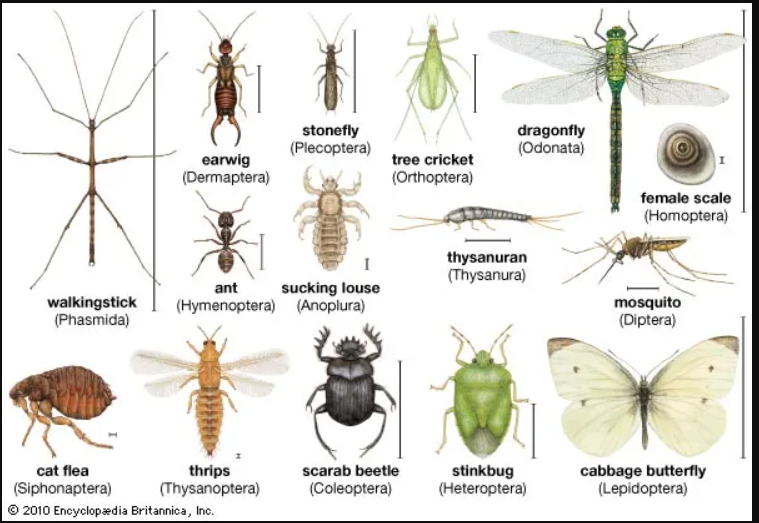
Different kinds of insects can be divided into groups called orders. There are many insect orders, and the biggest ones are listed below:
- Beetles (order Coleoptera, Greek for “sheath-winged”) have the front pair of wings changed into a hard shell to protect the back wings.
- Butterflies and moths (order Lepidoptera, Greek for “scale wing”) have large, often colorful wings made of tiny scales.
- Flies (order Diptera, Greek for “two wing”) have only one pair of wings.
- Ants, bees, and wasps (order Hymenoptera, Greek for “membrane wing”) sometimes have stingers and sometimes live in large colonies (like ant hills).
- True bugs (order Hemiptera, Greek for “half wing”) have a mouth that is long and narrow, like a drinking straw. This kind of mouth is called a beak.
- Grasshoppers (order Orthoptera, Greek for “straight wing”) can usually jump with their legs. They eat grass and grain plants.
- Dragonflies and damselflies (order Odonata, Greek for “tooth”) are top predators of other insects. Both aquatic nymphs and flying adults are carnivorous, and possess strong, toothed mandibles for biting prey.
- The stick and leaf insects make up an order which is entirely based on camouflage (order Phasmatodea, Greek for “phantom”).
Spiders, scorpions, and similar animals are not insects; they are arachnids. Arachnids are arthropods that have four pairs of legs, or eight legs total. Centipedes are also arthropods, but not insects. They are in a subphylum called the Myriapoda (Greek for “ten thousand foot”).