Look outside and you might notice tree branches swaying or flags waving in the breeze. All because of differences in air pressure. Even though we can’t see it, air is made of tiny, invisible molecules of different gases, mostly nitrogen and oxygen. These molecules are always moving around and bumping into things. Every time they bump into something, they push on it. This push is called air pressure.
Usually, air pressure is equal all around us. But something cool happens when air starts to move fast.
Fast-moving air has lower pressure than slow-moving air. A scientist named Daniel Bernoulli discovered this a long time ago. When air is standing still, it has lots of time to push hard on things. But when air is rushing past in a fast stream, it's in a hurry. It doesn't have time to push as hard, so its pressure drops.
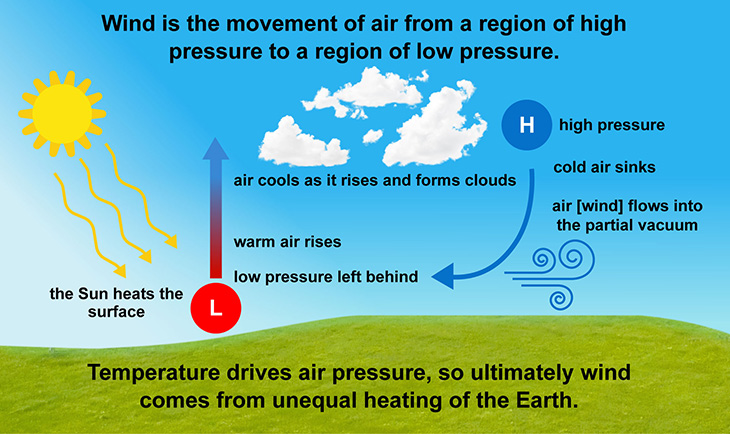
Image credit: John Childs
We see this play out every day in our weather. When giant columns of air, warmed by the sun, rise quickly, they create areas of low pressure. This can bring wind, rain, and storms.
The low pressure of fast-moving air is also how airplanes fly. An airplane's wing is shaped so that air zooms faster over the top, creating low pressure above the wing. The higher pressure underneath pushes the whole plane up into the sky!
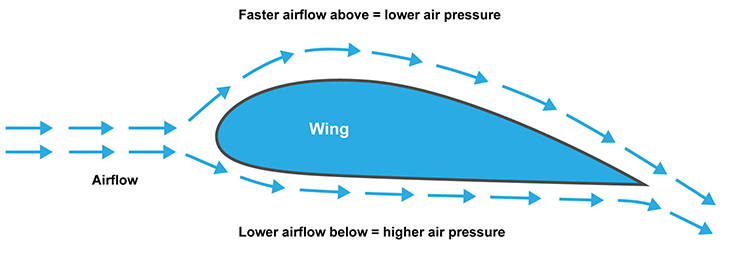
Image credit: John Childs
In this activity, you can see this rule in action with just a straw and a ball.
At the MagLab, scientists often work to eliminate air pressure from interfering with experiments. Samples are placed in a vacuum chamber within a high magnetic field so air molecules do not collide with the sample molecules, which could scatter them and destroy the measurements. Even though you can’t see it, air pressure can be a powerful force, as you’ll demonstrate in this simple experiment.
What You’ll Need
- Bendy straw
- Ping pong ball, small pom-pom, or other lightweight ball
What You’ll Do
1. Hold the straw in your hand with the long end to your lips and the bendy end pointing up.
2. Gently hold the ping pong ball above the bendy end of the straw.

3. Blow a steady stream of air through the straw.
4. Carefully let go of the ping pong ball in the stream of air.
5. Keep blowing steadily to levitate the ball in the air.

Your breath pushes up on the bottom of the ball. Gravity pulls down on the ball. When they match perfectly, the ball hovers! Why doesn't the ball roll off to the side and fall? The air coming out of the straw is moving fast, creating a low-pressure zone right around the ball. The quiet air in the rest of the room has high pressure. If the ball tries to escape to the side, the heavy, high-pressure room air pushes it right back into the fast air stream. The ball is trapped in an invisible cage of air pressure.
Did you know?
The air pressing down on you at sea level exerts a force of 14.7 pounds per square inch. This means the total weight of the atmosphere pressing on an average person's body is roughly 3,000 pounds, the weight of a small car. You don't get crushed because the fluids and gases inside your body are pushing outward with the exact same pressure.