When you look at a picture, it’s a flat image. If you turn it to the side, you don’t see the back of the person's head. That’s called a two-dimensional, or 2D image.
A hologram is different. It is a three-dimensional picture made of light. If you walk around a hologram, it looks like a real, solid object floating in mid-air. You can see it from the front, sides, and even look around it!
To make a hologram, scientists use lasers. A special mirror splits one laser into two separate paths. One laser shines onto the object. Another shines onto the camera film without hitting the object. When these two beams meet up again on the film, they crash into each other like ripples on a pond. They make a messy pattern of tiny swirls and lines. It doesn't look like anything at first, but when you shine a bright light through that messy pattern, the light bends and recreates the exact shape of the object. Your eyes see the light and trick your brain into thinking the real object is floating right in front of you.
How a Hologram is Created
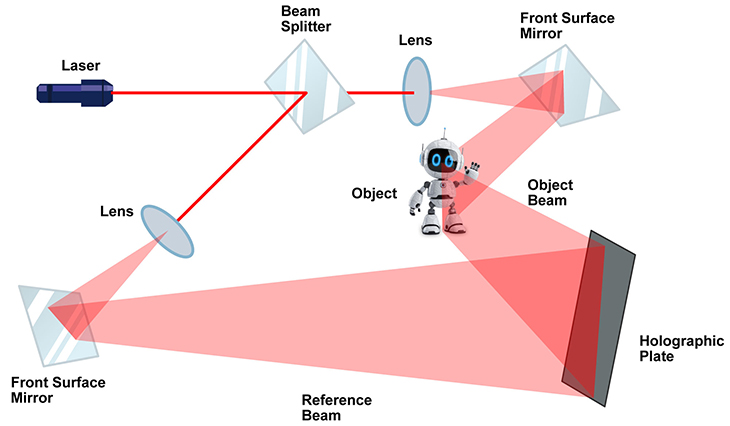
Image credit: John Childs
The MagLab doesn’t use lasers for holograms, but for materials research. Scientists shine powerful lasers into materials inside our powerful magnets. By watching how the bright light bounces off or passes through the material, scientists can see the tiny hidden parts of atoms. This helps them discover how electricity moves and how to build amazing new technologies.
Make Your Own "Hologram" Projector!
What You’ll Need:
- Clear, clean plastic from a soda bottle or plastic packaging
- A pen, a ruler, and scissors
- Clear tape
- A smartphone
What You’ll Do:
1. Use your ruler and pen to draw a shape called a trapezoid on your plastic. It should look like a triangle with the top point chopped off. Make the top edge about half an inch wide, the height one and a half inches tall, and the bottom edge two and a half inches wide. Cut it out, and use it as a pattern to cut out four identical pieces.
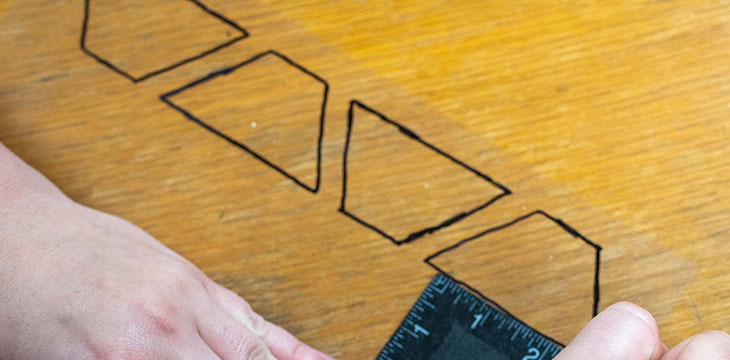
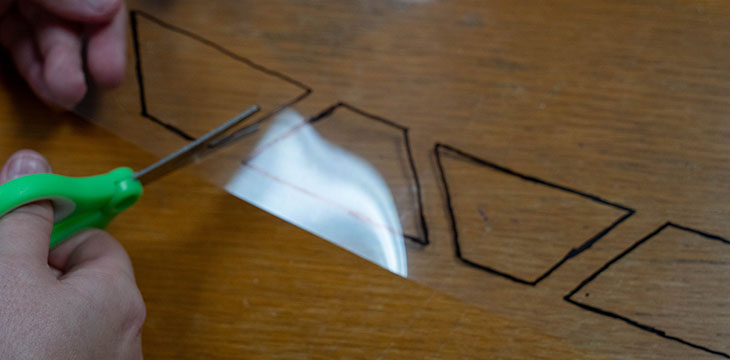
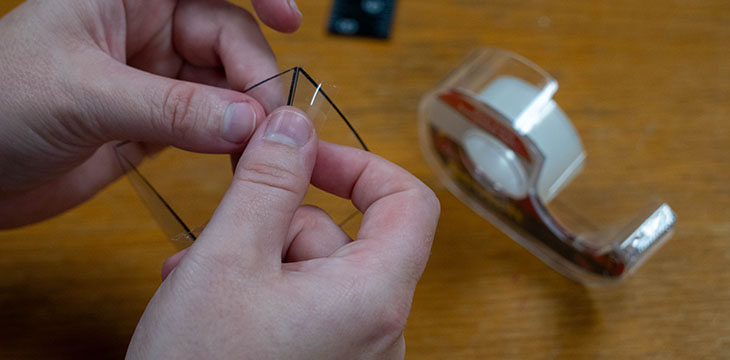
2. Tape the pieces together. Line up the edges side-by-side. Use small pieces of clear tape to connect them. When you tape the final two edges together, it will form a little plastic funnel or an upside-down pyramid.
3. Grab your phone and use our QR code to pull up the video. Or search YouTube for "4-way hologram video" or "pyramid hologram video." The videos should have a black screen and four tiny objects moving around in a cross shape.
 3D video QR code
4. Turn off all the lights in the room to make it super dark. Put your phone flat on the table and press play. Place the small opening of your plastic pyramid right in the dead center of the four moving pictures.
5. Look through the side of the plastic pyramid, keeping your eyes level with the screen. The light from the phone bounces off the clear walls and meets in the middle, making the image float right inside your plastic pyramid!
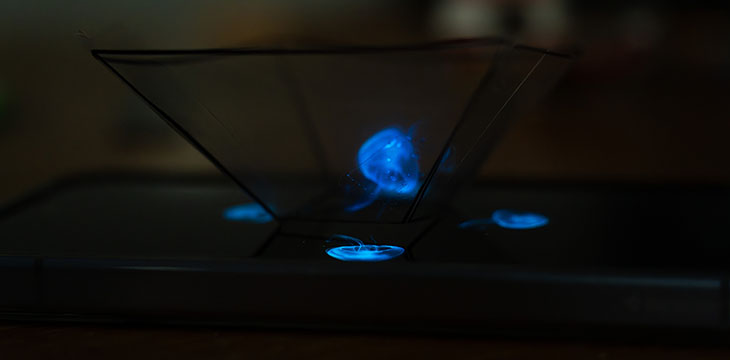
Why does this happen? Your brain believes light always travels in a straight line. When the light from the image on the phone bounces off the angled plastic and hits your eyes, your brain doesn't realize the light just took a sharp turn. Instead, it traces the light backward in a straight line through the plastic. Because you can see the room through the clear plastic, and the bounced light makes a reflection at the exact same time, your brain combines them. It tells you that an object is floating in front of you.
Reflection Illusion
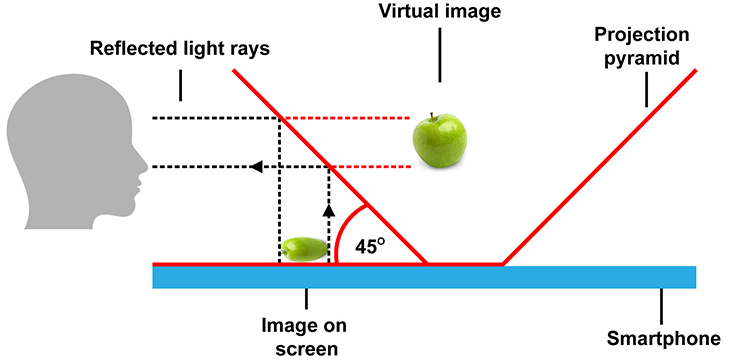
Image credit: John Childs
This is not a true hologram, but what’s called a ‘reflection illusion.’ Scientists use special lasers to make holograms, recording the actual shape of an object onto a piece of film. When you shine a light on a hologram, it recreates the light waves exactly as they bounced off the original object. This means, unlike with the reflection illusion you made, you can walk around a hologram and see it from the front sides, and back. In the reflection illusion, the image looks the same no matter which direction you look at it from.
Did You Know?
- Holograms are in your wallet: Look closely at a shiny credit card, a passport, or a 100 dollar bill. The shiny, silver sticker that changes when you tilt it is a hologram. Governments use them because they are incredibly difficult for bad guys to fake.
- Holograms can store whole libraries: Normal computer discs only save data on their flat surface. But holographic computers can save data inside the middle of a special glass crystal using lasers. A crystal about the size of your fingernail can hold thousands of movies.